
Reel Love: A Story Starring French and American Cinema
By Rebecca Leffler, American journalist who lives in Paris
Ask a French filmmaker about their influences and you are likely to hear American names like Tarantino, Scorsese, or Spielberg. Ask an American filmmaker and the French New Wave often comes first. Rebecca Leffler reports on the symbiotic relationship between French and American cinema at a moment when more American directors are making movies in France and French actors and filmmakers are gaining new visibility and success in the U.S.
When was cinema invented? It depends on who you ask. America lays claim to the Edison Company’s Kinetoscope in 1891 that allowed people to view moving pictures for the first time. France attributes it to the Lumière brothers who, in 1895, launched the cinematograph, a camera and a projector in one. Ever since, the two countries’ film industries have been inarguably intertwined. Much like literature in the nineteenth century or twentieth century jazz, cinema—known as “the seventh art form” in France—has become one of the most visible and reciprocal cultural exchanges between the country and the U.S.
Early French pioneers like Alice Guy-Blaché and Gaston Méliès, lured by “the American dream,” set up studios and produced films in the U.S. Meanwhile, Hollywood films have long dominated French screens. This dominance was reinforced after World War II by the Blum-Byrnes agreements, which sparked a flood of American films into France in exchange for debt relief. This subsequently caused fierce debates about protecting French cinema. The two film industries have co-existed for over a century with a symbiotic relationship, constantly nourishing and feeding off each other. While ostensibly similar, they are radically different in that the complex and world-revered French system is bolstered by state aid, while America is led by its Hollywood studio system.
Nevertheless, opposites do attract, and the love affair between the two industries has lasted for generations. Take Leo McCarey’s 1939 film, Love Affair, for example. A French man and American woman meet by chance and fall in love, but are separated by a twist of fate. Like its two main characters, the two countries’ cinema industries have often gone their separate ways, yet fate—or perhaps more recently, financing—continues to bring them together. The decades-spanning romance has really been heating up with a slew of Franco-American fusion fare. American director Richard Linklater made perhaps the most French film of 2025, Nouvelle Vague; Jim Jarmusch filmed his French-produced Father Mother Sister Brother partly in Paris; Jodie Foster speaks fluent French in Rebecca Zlotowski’s A Private Life; and Angelina Jolie stars in Alice Winocour’s Paris-set Couture. These films are no longer simply transatlantic trysts or transient trends—they represent a new era of blurred borders and more global cinema. And they may be getting all of the attention today, but it is no surprise considering the often forgotten cinema history that led us here.
The two countries’ cinema industries have often gone their separate ways, yet fate—or perhaps more recently, financing—continues to bring them together.
Let’s go back to the early twentieth century. Famed French illusionist and filmmaker Georges Méliès—best known for his landmark foray into special effects and science fiction with A Trip to the Moon—had a lesser-known older brother named Gaston who moved to the U.S. in 1903, first to manage his brother’s films, then produced dozens of his own shot across America. Alice Guy-Blaché, the world’s first female director, began at Gaumont in France. She went on to found the largest pre-Hollywood studio in America in 1910 in New York, and then in New Jersey, where she made hundreds of films. Although she was, until recently, nearly erased from cinema history, her work on both sides of the Atlantic was pivotal. She influenced Alfred Hitchcock, who influenced the French New Wave directors, who influenced American filmmakers, who influenced even more French directors, as an endless cycle was born.
As an American journalist based in France, for the past two decades, whenever I ask both famed French auteurs or first-time filmmakers about their cinematic influences, their first answers are typically American directors like Tarantino, Scorsese, and Spielberg. And whenever I ask American filmmakers that same question, they typically start with French directors, mostly from the New Wave.
FROM NEW WAVE TO NEW HOLLYWOOD
The French New Wave and its auteur theory, unconventional editing, and experimental storytelling of the late 1950s and early 1960s influenced America’s New Hollywood movement spanning the two decades that followed. Meanwhile, many French New Wave filmmakers said they drew inspiration from American directors like Alfred Hitchcock, Orson Welles, and John Ford.
In fact, François Truffaut famously conducted a series of recorded interviews in 1962 with Hitchcock that not only became the book Hitchcock/Truffaut, but also changed the way critics viewed the latter—elevating him from entertainer to serious auteur. To get Hitchcock to do the interviews, Truffaut wrote him a letter calling him “the greatest film director in the world” and telling him: “Since I have become a director myself, my admiration for you has in no way weakened; on the contrary, it has grown stronger and changed in nature. There are many directors with a love for the cinema, but what you possess is a love of celluloid itself.”
Such mutual admiration among legendary directors on both sides of the Atlantic has transcended multiple generations. Bertrand Tavernier wrote Amis Américains that featured dialogue with U.S. directors from John Huston, Elia Kazan, and Robert Altman to Quentin Tarantino, Joe Dante, and Alexander Payne.
In his 2011 film, Hugo, nominated for eleven Oscars, Martin Scorsese paid tribute to Méliès (Georges, that is—once again, poor Gaston, is forever usurped by his more famous family). “As a filmmaker, I feel like we owe everything to Georges Méliès. He invented everything, basically.” Scorsese has also cited Jean-Luc Godard’s cinema as taking his breath away, writing after the director’s death in 2022: “Godard redefined cinema on a minute-by-minute basis.”
Quentin Tarantino has cited Godard as a major influence on his early career, saying, “Godard did to movies what Bob Dylan did to music.”
Quentin Tarantino has also cited Godard as a major influence on his early career, saying, “Godard did to movies what Bob Dylan did to music,” and naming his production company A Band Apart after Godard’s 1964 Bande à part. Steven Spielberg has credited another New Wave filmmaker for one of his best known films, noting that Truffaut helped inspire him to make E.T.
In the other direction, French auteurs frequently cite American filmmakers as key influences. Michel Gondry, for example—who made a slew of American films like Eternal Sunshine of the Spotless Mind—has named Charlie Chaplin and David Lynch among his key influences: Chaplin’s blend of drama and comedy, Lynch’s way of abstracting story into feeling. Gondry shot and set his 2008 buddy comedy Be Kind Rewind in Passaic, New Jersey, an ode to popular American cinema like Ghostbusters, Driving Miss Daisy, and Rush Hour 2.
MODERN MUSINGS
The line between American and French cinema has become increasingly blurred as U.S. filmmakers flock to France for financing and creative freedom, and French filmmakers dip their toes into English-language projects with A-list casts and thus wider scope.
Producer and director Coralie Fargeat’s Los Angeles-set body-horror film, The Substance, was shot entirely in France starring Demi Moore as an aging actress who goes to extreme measures to preserve her youth with devastating consequences. The film was nominated for five Oscars, including Best Picture. “I felt this was the time for me to start thinking about making a movie with American partners while still preserving my way of doing things, which is very much European,” Fargeat told me ahead of the Oscars last year. She wrote the script in English to reach as many people as possible and has cited American genre influences from John Carpenter to Lynch and Kubrick.
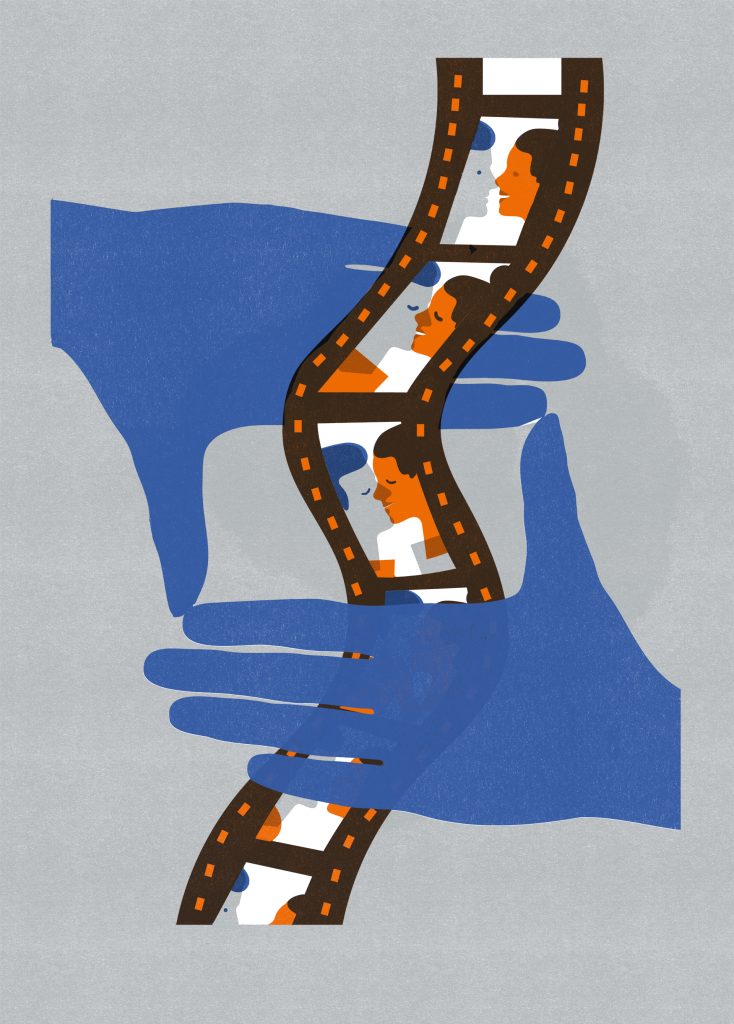
Illustration by Bérénice Milon
American actress-turned-director Kristen Stewart has been vocal about the fact that it took her nearly a decade to make her 2025 feature debut The Chronology of Water, which premiered at Cannes and won the Deauville American Film Festival’s Revelation prize. She cites French director Olivier Assayas (who directed her in Personal Shopper) as an influence on her style, and, during a masterclass at the 2025 festival, spoke about how her favorite French movies have inspired her—from Louis Malle’s Elevator to the Gallows to Alain Resnais’ Hiroshima Mon Amour, Catherine Breillat’s A Real Young Girl, and Leos Carax’s The Lovers on the Bridge. She credits French producer Charles Gillibert of CG Cinema with being key to getting the long-gestating project off the ground. Gillibert told me recently: “One of the questions I always ask as a producer is, ‘How do I make the film the filmmaker wants to make while dealing with its budget?’ Kristen took more than ten years to make her film. I jumped in more recently, but in the end she made the film she wanted to make.”
As the climate for making independent films in the U.S. grows increasingly complicated—both in terms of finding funding and making films outside of the studio system, or with streamers—such creative freedom, coupled with enticing public funding and tax credits, is luring American filmmakers to France. Gillibert also produced Jim Jarmusch’s Venice Golden Lion–winning Father Mother Sister Brother. The family-focused triptych about the relationships between adult children and their parents is set between the U.S., Ireland and France, and shot in Paris in March 2024. Alice Winocour’s Paris fashion-week-centered Couture is a true French-American collaboration, produced by CG Cinema alongside U.S. production house Closer Media. The film is technically a French production, but stars Angelina Jolie and is a blend of English, French, and Dinka and Swahili, languages spoken in South Sudan. Winocour told me that she has had a self-described “obsessional relationship with cinema” and has been “a cinephile since I was a child.” While also influenced by the French New Wave, she says that for a time, “I was obsessed by one director in particular: Alfred Hitchcock.”
Other recent Franco-American mash-ups include Rebecca Zlotowski’s A Private Life, starring Jodie Foster as a psychoanalyst investigating a suspicious death, that premiered in Cannes before a global festival tour and early Oscar buzz. Olivier Assayas’ The Wizard of the Kremlin stars American actor Paul Dano in the lead role in an English-language film that first bowed in Venice. Yann Gozlan’s forthcoming French release Guru was shot between Paris and Las Vegas and dives into the American concept of life coaching.
NOUVELLE VAGUE
These recent films are not simply cases of American directors making French films and vice versa, but of each bringing their respective sensibilities and outsider perspectives for unique unions of both countries. Richard Linklater’s latest film, Nouvelle Vague, is the epitome of this. It follows the production of Jean-Luc Godard’s 1960 film Breathless, a pivotal moment in the French New Wave and in the evolution of filmmaking. Linklater previously shot the second film in his trilogy, 2004’s Before Sunset, starring Julie Delpy and Ethan Hawke, entirely in Paris, but that was an American film and mostly in English, whereas Nouvelle Vague is produced by Michèle Halberstadt Pétin and Laurent Pétin of France’s ARP. It stars an almost fully French cast other than Zoey Deutch as Jean Seberg, and has a Paris-based crew.
Linklater told me in a recent interview: “We were on hallowed ground in the French film industry, but I think they liked that there was an American doing it. I didn’t feel the same weight of the French New Wave that a French person might. These aren’t my elders or my fathers and grandfathers—I’m just a fan.” Halberstadt agrees. “It is an American’s vision of French cinema. A French director could not have made this film.”
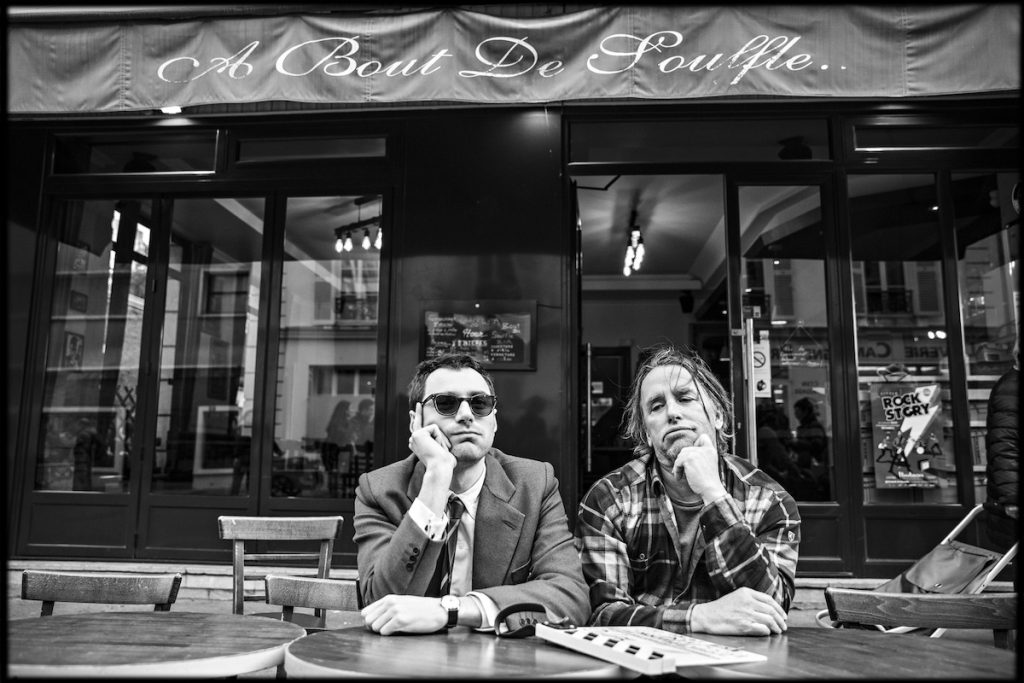
Nouvelle Vague star Guillaume Marbeck and director Richard Linklater. Photograph by Jean-Louis Fernandez.
According to Linklater, “Genre-wise, there is something cyclical going. Godard was making a low-budget film inspired directly by American gangster films. He was doing his own French twist on that genre. Nouvelle Vague is the French New Wave filtered through an American consciousness.”
When I asked him about his influences as a director, he said: “I get the question a lot. What is more inspiring—the New Hollywood of the 1970s or the French New Wave? I always say the New Wave. Here were these writer-critics now making films about very different subject matters, twisting genres, telling personal stories, and that’s why they became such an inspiration for the next generations of filmmakers.”
American directors shooting in a foreign country also brings added enthusiasm, which is reflected on the screen. As for returning to France to film, he told me: “I love Paris. It’s all the streets my heroes walked and where they made films. I’m the luckiest filmmaker in the world.” He also credits the country’s film-financing system: “The film industry of France is wonderful in the way they operate and take care of themselves. We did get support from the CNC, the French National Centre of Cinema, and I don’t take that lightly, that meant everything. France is the home of the auteur and that is how all films should be.”
BLURRED BORDERS
From Gene Kelly dancing his way through the Place de la Concorde in Vincente Minnelli’s 1951 musical An American in Paris and Owen Wilson running into Ernest Hemingway and Gertrude Stein in Midnight in Paris to Lily Collins jogging along the Seine in Emily in Paris, the French capital has become Hollywood’s favorite place for on-screen escapism. France is not just a place to capture postcard Paris. In Alfred Hitchcock’s 1955 film, To Catch a Thief, Cary Grant and Grace Kelly drive from La Croisette through Nice to Monaco; Steve Martin and Michael Caine play rival con men on the Riviera in Frank Oz’s 1988 comedy, Dirty Rotten Scoundrels; and Tom McCarthy sets his 2020 feature, Stillwater, in Marseille, starring Matt Damon as an oil-rig worker from Oklahoma who teams up with a Frenchwoman (Camille Cottin) to prove his daughter’s innocence. In the other direction, filmmakers like Luc Besson (The Professional, The Fifth Element, Lucy) and his one-time assistant turned prodigy Louis Leterrier (The Transporter films, The Incredible Hulk, Clash of the Titans, Fast X, and the forthcoming sci-fi horror 11817 ) have seamlessly made the jump to blockbuster English-language films.
Jean Seberg famously starred in Jean-Luc Godard’s Breathless, speaking French with an American accent (see: Nouvelle Vague), and other U.S. actors have followed—John Malkovich speaks French in Gilles Legardinier’s 2023 film, Mr. Blake at Your Service!, and Jodie Foster shows off her French-language skills in A Private Life; Angelina Jolie speaks French on occasion in Couture alongside French actors like Vincent Lindon and Louis Garrel, who act in English.
Actors like Juliette Binoche, Marion Cotillard, Omar Sy, Vincent Cassel, Jean Reno, and Léa Seydoux are also all recognizable faces on U.S. screens.
KEEPING THE LOVE ALIVE, YEAR AFTER YEAR
What is the secret to such a long-term love affair between French and American cinema? Annual getaways to the sea never hurt. Film festivals have always been a crossroads between the two cultures, in particular Cannes—perhaps the best example of an event that has bridged the French and American film industries with a signature blend of auteur cinema and red-carpet glamour. It is a hub for cinema from all over the world, but films from its native France and across the Atlantic have long dominated both the lineups and premieres.
What is the secret to such a long-term love affair between French and American cinema? Annual getaways to the sea never hurt.
In another seaside town in Normandy, the Deauville American Film Festival is a celebration of American cinema that has existed since 1975 and continues to spotlight U.S. indie cinema in competition while welcoming Hollywood stars for premieres, masterclasses, and tributes. It even features in Joachim Trier’s Sentimental Value, with scenes in both cinema venues and on the Normandy beach where director Gustav Borg (Stellan Skarsgård) meets an American actress (Elle Fanning) meant to play a fictional version of his own daughter in his next movie.
In Los Angeles, at the annual American French Film Festival, French cinema and series are in the spotlight. Launched and produced by the Franco-American Cultural Fund, it screens some seventy French films and series, and the 2025 line-up epitomizes what the festival’s deputy director Anouchka van Riel calls “a major trend in crossover films.” She explains: “A Private Life echoes New Wave themes of subjectivity, existentialism, and inner psychology while using tropes from American film. In Nouvelle Vague, Linklater deals with all the grammar of the New Wave—like Godard’s improvisation—but does it in a playful and iconic American manner.” She adds: “It is peak cultural exchange and transatlantic synergy.”
Such Franco-American festival selections also highlight the fact that in a time when film financing is increasingly complicated and coproductions are ubiquitous, a film’s identity has become more difficult to define. Technically, a film is identified by the country that is the majority producer, but in France, a film is traditionally defined by its auteur, or writer-director. Just as the question of who really invented cinema is subjective today, the question is: Is a film like Nouvelle Vague—in French with a French cast and mostly French crew—a French film if it is directed by an American? Is an English-language film with an A-list American cast and set in Hollywood helmed by a French auteur (like Coralie Fargeat’s The Substance) a French or a Hollywood film?
Like any long-term relationship, the two cinemas continue to learn from each other and, though often contentious—at the box office, in film-festival competitions, or for audience attention on screens of all sizes—recent films prove that their love has stood the test of time and they are better together, n’est-ce pas?
Rebecca Leffler is the France correspondent for Screen International and the former France correspondent for The Hollywood Reporter. She previously wrote for States about a new generation of women filmmakers reshaping French cinema.
This essay first appeared in States, the annual magazine of Villa Albertine, published in January 2026.
Related content
Democracy in Two Worlds: A History of the Franco-American Alliance

Lafayette on Both Sides of the Atlantic
Sister Republics: Two Visions of Liberty
The Declaration of Independence: A Global Legacy
Tocqueville: A Thinker for Uncertain Times

The Empty Throne: From Kings to Presidents
Archipelagoes of Art: A Transatlantic Museum Dialogue
My American Lessons
Who Shapes the Avant-Garde Now?

Big Theory: How America Brought French Theory to the World
Portfolio: Transatlantic Dreams
Between Fascination and Rivalry: 250 Years of Cultural Exchange
Five Years of Artists’ Residencies Across the United States
Sign up to receive exclusive news and updates Subscribe