

The Declaration of Independence: A Global Legacy
By Lionel Cuillé, professor of French at Washington University in St. Louis
The United States is celebrating the Declaration of Independence’s 250th anniversary with a nationwide series of exhibitions and commemorations. Yet the document is more than a national origin story. Its words inspired a movement for human rights around the world.
In 2026, the U.S. will commemorate the 250th anniversary of the Declaration of Independence, a document whose message of equality continues to resonate around the world. As part of the nationwide America250 initiative, a coordinated season of events will mark this historic milestone with exhibitions, public programs, and new installations across leading cultural institutions. The Smithsonian will lead with Our Shared Future: 250, alongside the National Museum of American History’s In Pursuit of Life, Liberty & Happiness. The National Constitution Center will unveil two new galleries. The National Archives’ Declaration250 initiative will count down to July 4 with special programming, while the Library of Congress will expand its public offerings to engage new audiences. The Museum of the American Revolution’s exhibition The Declaration’s Journey will trace the global impact and evolving legacy of the Declaration itself. Together, these efforts highlight a shared commitment to reflection and education as the nation marks a quarter-millennium of independence.
From its first lines, the Declaration sets out ideas meant to be universal: inalienable rights no authority may abrogate, legitimate power grounded in the consent of the governed, and the people’s right “to alter or to abolish” a government that violates those principles. It was printed on broadsides, posted in public, read aloud. The document was intended to become part of civic life. It was translated quickly, imitated widely, and adopted as a common idiom for judging political legitimacy. Celebrating 1776 today is to measure our institutions against that promise of equality, and to ask how we should act when practice falls short of principle.
The Declaration sets out ideas meant to be universal: inalienable rights no authority may abrogate, legitimate power grounded in the consent of the governed, and the people’s right “to alter or to abolish” a government that violates those principles. It was printed on broadsides, posted in public, read aloud.
French translations appeared as early as 1776–77, often printed beside new state constitutions from Virginia, Pennsylvania, and Massachusetts. Those constitutions made a striking impression on French readers. The Virginia Declaration of Rights (June 1776) had already stated that the power of government rests on the people and that “a majority of the community hath an indubitable, unalienable, and indefeasible right to reform, alter, or abolish it.” Similar language appeared in the constitutions of Pennsylvania (1776) and Massachusetts (1780), giving French observers concrete models of a constitution led by first principles.
The circulation of ideas also relied on a network of people. Thomas Jefferson, serving in Paris from 1785 to 1789, was a central figure in these exchanges. In the spring of 1789, the Marquis de Lafayette asked him to give recommendations for a French declaration of rights. Jefferson responded with a concise “Charter of Rights” (dated June 3, 1789) and continued to advise on Lafayette’s evolving draft; surviving manuscripts show a rich exchange of ideas in the margins. By August 1789, when the National Assembly debated what became the Declaration of the Rights of Man and of the Citizen, there were already key terms that had become familiar on both sides of the Atlantic: liberty, equality, security, popular sovereignty, and the right to resist oppression.
French debates also drew on domestic traditions. From Enlightenment political thinkers, notably Rousseau, came the insistence on universal, antecedent rights and the people as the source of sovereignty. From Montesquieu, deputies borrowed a constitutional grammar, most visibly in Article 16 (which held that there is “no constitution” without a separation of powers), a principle intended to bind authority by law. From parliamentary constitutionalism, the French also inherited a long-standing legal polemic against arbitrary power and lettres de cachet, sealed royal orders handed down without due process. Finally, the cahiers de doléances, lists of grievances drafted by communities across France, and broader Enlightenment reformism turned these doctrines into concrete political demands—religious tolerance, due process, limits on unreasonable punishment, equal citizenship—that the Assembly condensed into the 1789 text.
The American Declaration says why a people may found a state; the French Declaration of the Rights of Man and of the Citizen states how the government must respect rights.
The American experience supplied persuasive examples and ready language, accelerating a French project already underway. Read together, the two declarations perform distinct political functions. The 1776 Declaration is a public brief: it states universal principles and lists grievances to justify independence. The 1789 Declaration is a rights charter placed before the constitution: it sets rules for lawmakers and courts—equality and natural rights (Articles 1–2), legality and due process (Articles 8–11), separation of powers (Article 16). The American Declaration says why a people may found a state; the French Declaration of the Rights of Man and of the Citizen states how the government must respect rights. Later movements borrowed from the American example to declare independence—and the French document to elaborate the rights of citizens.
As David Armitage shows in The Declaration of Independence: A Global History, the American Declaration was written to address both domestic and international audiences, introducing the United States of America to the world, making it “a declaration of interdependence as much as independence.” In contrast, the French Declaration of the Rights of Man and of the Citizen had a greater global impact as a charter of individual rights. 1776 proclaims sovereignty to the world; 1789 codifies rights to shape a just civic order.
In partnership with the Ohio State University, the University of Wisconsin–Madison, and the University of Illinois Urbana–Champaign, Washington University in St. Louis is organizing a yearlong cycle focused on the transatlantic revolutions and the birth of human rights that will link memory, research, and civic engagement. Across the partner campuses, prominent French and U.S. scholars will deliver keynotes and offer seminars. Interdisciplinary roundtables, including faculty in history, law, political science, philosophy, literature, and library studies will unpack what 1776 and 1789 have in common.
Neither the American nor the French declaration delivered human rights to all in 1776 or 1789. Slavery persisted; women continued to be excluded from civic participation; countless voices were missing. And yet, by asserting universal principles and enumerating rights that were framed as nonnegotiable, these documents created a language that later claimants could use. The paradox is the point: words first used by the powerful became tools for the excluded. If “human rights” means anything today, it’s because generations made those words matter, expanding their reach until the circle widened to include the very people once left out.
Lionel Cuillé is director of the French Connexions Cultural Center at Washington University in St. Louis, part of the Centers of Excellence University Network. His teaching and research focus on contemporary French poetry, avant-garde movements, and the representation of speed at the turn of the twentieth century.
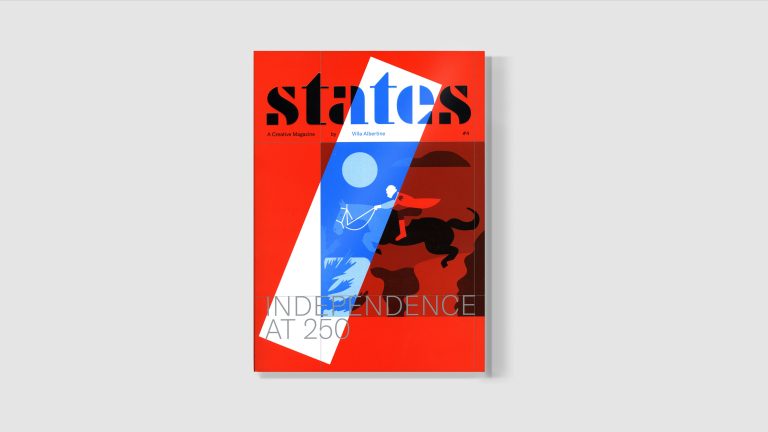
This essay first appeared in States, the annual magazine of Villa Albertine, published in January 2026.
Related content

Democracy in Two Worlds: A History of the Franco-American Alliance

Lafayette on Both Sides of the Atlantic

Sister Republics: Two Visions of Liberty

Tocqueville: A Thinker for Uncertain Times

The Empty Throne: From Kings to Presidents

Archipelagoes of Art: A Transatlantic Museum Dialogue
My American Lessons

Who Shapes the Avant-Garde Now?

Big Theory: How America Brought French Theory to the World

Reel Love: A Story Starring French and American Cinema

Portfolio: Transatlantic Dreams

Between Fascination and Rivalry: 250 Years of Cultural Exchange
Five Years of Artists’ Residencies Across the United States
Sign up to receive exclusive news and updates Subscribe