
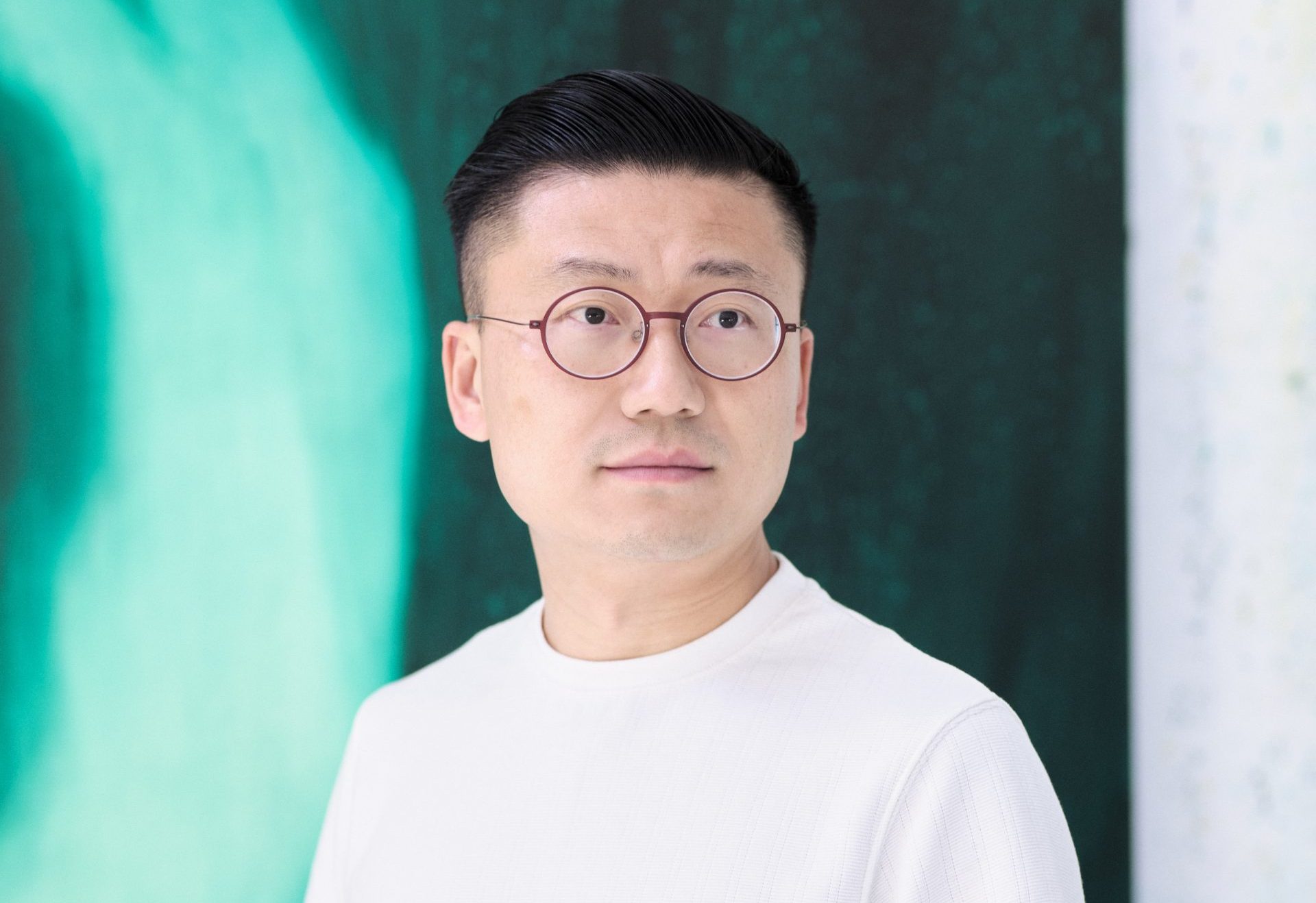
Xie Lei
Artist
November-December 2027
- Visual Arts
- San Francisco

“Xie Lei will immerse himself in San Francisco’s Asian and LGBTQIA+ communities, examining coexistence with them: how one can absorb another culture while preserving one’s own.”
Out of conviction, I chose painting because it opens a path toward a language capable of expressing my sensorial world, as well as a field of experimentation through which to explore the specificity of this medium in a contemporary context. My practice begins with reality but moves away from it in order to explore ambiguous, uncertain worlds transformed by my imagination. Most of my paintings refer to unsettling or disquieting situations, subtly connected to literary and cinematic memories, or drawn from the deepest well of feeling.
My work is concerned with the complexity of events and situations, and above all with their ambiguities and tensions. My recent paintings are marked by an in-between state—that of sleep and death. The colours are dark, yet they shift and become luminous and powerful. My practice is also distinguished by another perception of time: it offers a much-needed slowing of the gaze, an escape from the intoxication of acceleration and immediacy.
Xie Lei, born in China in 1983, has lived and worked in Paris since 2006. He graduated from the Central Academy of Fine Arts in Beijing and the École nationale supérieure des Beaux-Arts de Paris. He was awarded the 2025 Marcel Duchamp Prize. His work has been exhibited at numerous institutions, including the Musée d’Art Moderne de Paris; Fondation Louis Vuitton, Paris; MO.CO., Montpellier; CAPC, Bordeaux; Villa Noailles, Hyères; Collection Lambert, Avignon; MAC VAL, Vitry-sur-Seine; Langen Foundation, Neuss, Germany; the Musée national de l’histoire de l’immigration, Paris; and Fondation d’entreprise Ricard, Paris. His work is held in public and private collections, including Thyssen-Bornemisza Art Contemporary, MAC VAL, and the Albertina Museum.
Since arriving in France in 2006, the idea of coexistence has always interested me: how can one absorb another culture while preserving one’s own? This question has nourished my painting practice for nearly twenty years.
This research seeks to understand both the dynamics and the shortcomings of coexistence in San Francisco, a city home to one of the largest Asian communities outside Asia, including a significant LGBTQIA+ population. It addresses questions of identity and gender in contemporary American society and in its history.
These two months of residency will be a period of immersion in the city, of sustained attention, and of learning how it functions. These unprecedented conditions—this immersion in San Francisco and in the lives of these communities—will allow me to understand their codes and habits through the places where they meet and intersect.
This is not, however, a sociological or historical study. The project aims to provide new image sources for my work, drawn from the signs and symbols conveyed, diverted, or reinvented by these communities. Silences, tolerance, prohibitions, and transgressions are all elements of the realities experienced by these communities.
The residency is intended as a double displacement: both through what is observed and through the way these images may act upon the iconography of my work. It will result in a new corpus of images and paintings. Resisting both ostracism and literalness, these sources will not be directly identifiable in the paintings, as is the case throughout my work. This singular cultural transition is logically part of the construction of the content of images and the question of representation.
From the mid-nineteenth century onward, San Francisco became the main point of entry for the Chinese community in the United States. The Chinese Exclusion Act of 1882, which remained in force until 1943, led to the development of a highly self-contained community in Chinatown. In New York, the significant establishment of a Chinese community dates from the 1960s. San Francisco therefore represents the earliest Chinese community in the United States.
My research will draw on documentary sources collected on site, both historical and contemporary, from associations and cultural centres such as 41 Ross, which develops numerous local initiatives. This residency will also give me access to the Chinese Center at the San Francisco Public Library, which preserves documents relating to the history of the Chinese community.
In partnership with

ADIAF
The Association for the International Diffusion of French Art brings together 300 collectors of modern art who are fully committed to the creativity quest. It was created in 1994 with the ambition to highlight the flourishing creativity of the French artistic scene and to promote the French art scene throughout the world. ADIAF has created in 2000 the Prix Marcel Duchamp which is awarded annually to one among four shortlisted artists either born or residing in France and working in the field of visual arts. Organized since its founding in partnership with the Centre Pompidou, this seminal art Prize is considered today one of the most relevant vectors of information on contemporary art in France.