

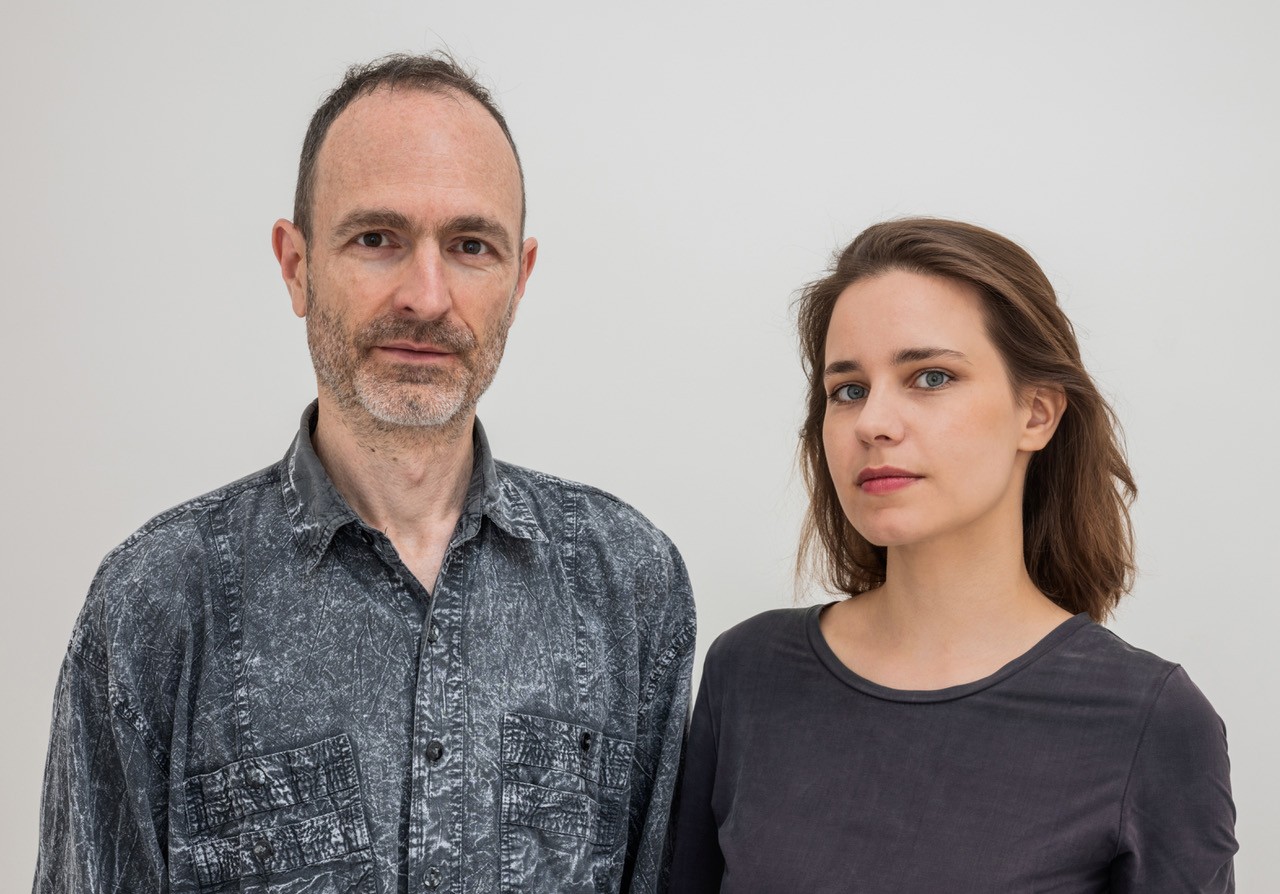
Stéphane Degoutin & Juliette Terreaux
Urban studies researcher ; Artist, set designer, and miniaturist
April - May 2027
- Architecture
- Chicago

“We are creating an exact scale model of the Chicago Playboy Mansion in order to understand how this system was able to exert power over and subjugate so many women. Our aim is to reveal the mechanisms of an architecture of predation.”
We are Stéphane Degoutin and Juliette Terreaux. Juliette works on recreating hidden, vanished, or inaccessible places through models, photographs, and installations. Her projects engage with heritage sites, mediated intimate spheres, and domestic spaces shaped by fantasy and domination. Each work is accompanied by on-site research and the development of a substantial bibliographic and archival corpus. While she considers the historical dimension fundamental, her practice does not seek to replace that of the historian; it remains, above all, an artistic translation.
Stéphane explore “dark systems”: structures that often go unnoticed yet organize our lives—from air conditioning and international airports to music for houseplants and urban infrastructure. Drawing on long-term research and patient collecting, He assembles the diverse fragments encountered along the way in an attempt to make sense of them. He sometimes work alone, but most often in collaboration with other researchers or artists. The outcome may be a book, a film, an installation, a lecture-performance, or several of these forms simultaneously. Whatever the form, these works are essays.
Juliette Terreaux is a French-Swiss multidisciplinary artist and a graduate of the École nationale supérieure des Arts Décoratifs in Paris and École Duperré. Her work explores the relationships between reality, representation, and perception through sculptures and miniature spaces that translate into three dimensions images drawn from media, archives, and cinema. She develops collaborations in France and internationally across contemporary art, film, architecture, heritage, and olfactory creation.
Stéphane Degoutin was born in Toronto, Canada. He lives and works in Paris, where he is a researcher at the Infrastructure, Architecture, Territory Laboratory and teaches at the École nationale supérieure des Arts Décoratifs.
Major works :
- Prisonniers volontaires du rêve américain, essay, 2006, Éditions de la Villette.
- World Brain, essay film, with Gwenola Wagon, 2014, Arte Creative.
- Psychanalyse de l’aéroport international, essay, with Gwenola Wagon, 2019, Éditions 369.
- Erewhon, essay film, with Gwenola Wagon and Pierre Cassou-Noguès, 2019.
- La colonisation de l’air, forthcoming essay.
We are investigating an unusual building at the margins of architectural history: the first Playboy Mansion, built in Chicago in the 1950s and home to Hugh Hefner, the magazine’s founder.
The interior of this vast 4,000-square-metre, seventy-room building was filled with secret passages, hidden spaces, voyeuristic devices, and surveillance systems. This apparatus had one purpose: to direct every woman towards the same place—Hefner’s bed.
We did not arrive at this subject out of a fascination with Playboy; it is neither our milieu nor our culture. Our entry point is our interest in architecture and our reading of Paul B. Preciado’s Pornotopia, which analyses the Playboy Mansion as a spatial and multimedia apparatus. It is a particular type of architecture placed in the service of sexual conquest. It embodies an extreme form of male domestic space, for which the magazine itself provided instructions.
We want to understand how this spatial system was able to exert such power over women and subject them so effectively. Our aim is to reveal the mechanisms of this architecture of predation.
To do so, we are undertaking the most accurate reconstruction of the site possible. After several years of collecting archival documents and conducting interviews with former residents, we are producing an exact scale model of the Chicago mansion.
We will extend this research through fieldwork: travelling to the site and meeting women who lived in the Playboy Mansion. We will present them with the miniature model as a kind of transitional object—one that may allow their voices and memories to emerge.
This research will contribute to the writing of an essay film. The aim is to tell the history of the site through its model.
The Chicago Playboy Mansion became an icon of its time before being overshadowed by the second Mansion—the Hollywood residence where Hefner lived from the 1970s until his death in 2017. The latter embodies the decline and excesses of the system he established. Since Hefner’s death, many women who shared his life have described from within the mechanisms of predation at work.
The Chicago Mansion, by contrast, represents an earlier moment, when Playboy could still be perceived as progressive and Hugh Hefner as a successful, attractive, and socially influential man. Describing the highly specific workings of this building provides an opportunity to examine how this prototype was first developed.
Having gathered a substantial body of documents remotely, including the house plans, we now plan to continue the investigation on site in Chicago. We hope to visit the building—or what remains of it, since the Mansion has been subdivided into luxury apartments. In the Chicago suburbs, we will also visit Hefner’s childhood home. Some of the clubs that inspired him still exist, including the best-known among them, the aptly named Gaslight Club.
We will collect materials from the historical archives of the Art Institute of Chicago and the Chicago History Museum. We will also contact former Playmates who lived in the Mansion during the 1960s.
Some of these former residents are still alive, but are now in their eighties or even nineties. It is therefore urgent to interview them and liste
In partnership with

DROP! La chambre des méthodes

LIAT Laboratory (Paris Malaquais National Architecture School)
For over twenty years, the LIAT laboratory has been pursuing a scientific program that questions the relationship between architecture and infrastructure. It focuses on the analysis of contexts (cities, territories, landscapes) marked by the development of infrastructure and major facilities, through a specific approach based on historical research, critical analysis of projects, case studies and the creation of a history of ideas.

The Art Institute of Chicago