

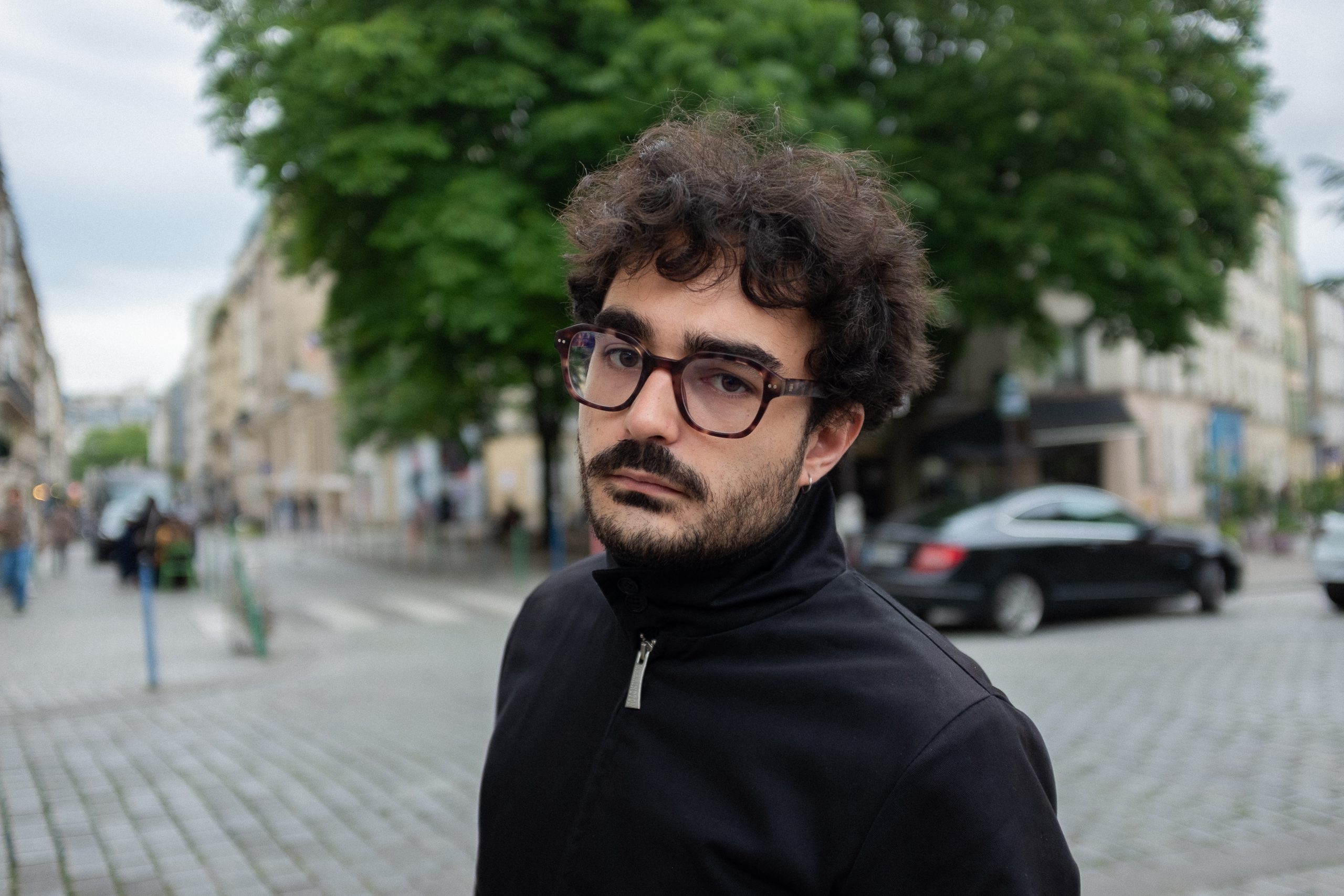
Martin Hiltenbrand
Artist-researcher
Summer 2027
- Museums
- Boston

“What does it mean, for a community that is still present, to listen to voices recorded within a framework that assumed they were destined to disappear? “
My practice as an artist-researcher focuses on sound archives and the affects they trigger in us. From wax cylinders to magnetic tapes, I explore the materiality of these memory-bearing media, as well as the discourses and uses of those who activate and receive them. In a world where sound reproduction seems to have released time from its moorings, my practice is drawn to these echoes of the past; by taking their side, I seek to understand what these disembodied voices demand of us and what they reveal about the unspoken choices that have shaped our contemporary world.
The central premise of my practice is to consider sound archives as objects that exceed their function as historical documents. Their spectral mode of manifestation, the grain of the voices, and the contexts surrounding their recording: all these elements compel us, in my view, to consider them as agents of disturbance, persistent and unsettling testimonies to a past whose memory is fading. Silenced colonial pasts, songs of disappointed utopias, trills of extinct birds: my practice always begins with a site where an archival collection is reactivated and where the voices it releases come to unsettle our present. At the intersection of sound studies, literature, and sound art, I explore these manifestations of the past in the present through theoretical and literary writing, augmented by sound-based installations and devices.
Villa Albertine offers me an exceptional opportunity to document the reactivation of one of the earliest sound archives ever recorded. The Passamaquoddy Wax Collection and the process of cultural reclamation currently unfolding in northern New England will allow me to make a decisive advance in my research.
Martin Hiltenbrand is an artist-researcher based in Paris. Trained in philosophy at the Sorbonne and in research-creation through the EUR ArTeC program, his practice brings together literature, sound installation, and research in the field of sound studies. His research focuses on the haunted dimension of sound archives. By considering the voices sedimented in the past as manifestations of forgotten political memories, he explores, both theoretically and artistically, the unfulfilled promises, failed utopias, and repressed conflicts that shape Western societies.
Between 1890 and 1891, Jesse Walter Fewkes produced what is now considered one of the earliest sound archives ever recorded. Armed with an Edison phonograph, he traveled to Maine to record ritual songs within the Passamaquoddy community. This undertaking was rooted in a colonialist assumption that the Passamaquoddy were on the verge of disappearing. This motivation lends the project a macabre dimension: does archiving not amount to condemning something to death? In light of this, listening to the collection inevitably creates a sense of unease, as though the Passamaquoddy voices recorded there had been buried alive.
Yet when Dwayne Tomah, one of the last speakers of the Passamaquoddy language, was asked by Native Voice One, “What would you like the public to know?”, he replied: “Mecote yut kilun ktiyulotipon!” — “We are still here.” Fewkes’s prophecy has been proven wrong: the Passamaquoddy have not disappeared. They are contemporaries of an archive that was supposedly meant to document their disappearance, and they are the ones now reinterpreting and reclaiming it.
My residency project aims to document this unique situation alongside the Passamaquoddy researchers, language speakers, and cultural practitioners involved in this process of reactivation. I intend to conduct interviews, attend collective listening sessions, document acts of translation, and gather the stories associated with the songs, voices, and silences imprinted by the wax onto these cylinders.
By focusing as much on the archives themselves as on what they provoke, I will explore the affects and forms of transmission that emerge from this sonic relationship. What does it mean, for a community that is still present, to listen to voices recorded within a framework that assumed they were destined to disappear? The residency will result in field notebooks and sound documentation, situated at the intersection of investigation, critical narrative, and sound composition.
This project can only be carried out in the United States, more specifically at Pleasant Point (Sipayik), in northern Maine, as this is where the situated process of reclaiming the Passamaquoddy Wax Cylinder Collection is currently unfolding. This contemporary relationship with the recordings cannot be understood from a distance: it requires an extended immersion in the places themselves, in close contact with the practices through which these archives acquire meaning.
As the primary site for the preservation and transmission of Passamaquoddy heritage, the Waponahki Museum & Resource Center will be my first point of contact. By immersing myself in the rhythms of its cultural life, I will be able to document these acts of reclamation as closely as possible, while also seeking, on my own modest scale, to contribute through my skills as an artist-researcher. These contributions will be developed in consultation with local researchers, with the aim of neither duplicating work already underway nor positioning myself above it.
While one of the aims of this immersion is to build a body of local documentation, it is also a means of creating a transatlantic space of exchange between the Passamaquoddy community and the fields of research and artistic practice in France. Although it is one of the earliest sound archives in history, the collection remains largely absent from French academic discourse. Documenting and translating this situation will help bring it to greater attention in France, while also creating opportunities for the Passamaquoddy to engage with new interlocutors.
In partnership with
EUR ArTeC
EUR ArTeC is a graduate research school dedicated to developing and promoting research-creation at the intersection of artistic practice and academic research.