

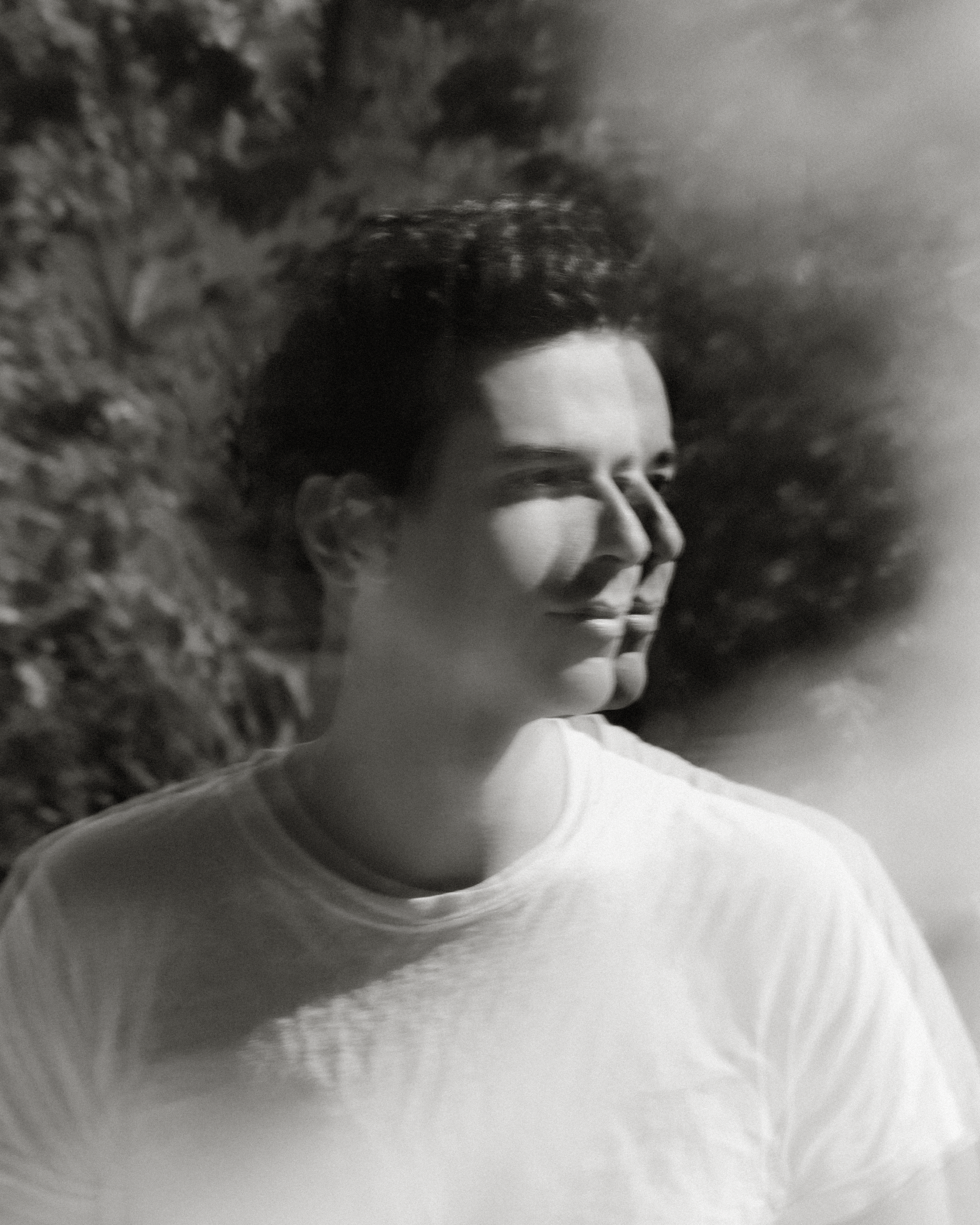
Harry Allouche
Composer, Pianist
January - March 2027
- Music
- Los Angeles


“To trace the making of the Hollywood orchestral sound, uncover a genealogy of cinematic affects, and let it inspire a work to come.”
I am a French composer and pianist. Since childhood, one fascination has stayed with me: how visible and invisible structures shape our sense of time; how, beneath a story, harmony and orchestration become a fabric of memory and affects, opening an endless space for imagination. I come from a family whose memory goes back to Salonica. It has made me attentive to music as something that travels, carried across borders, transformed, and remade far from where it began.
At the Paris Conservatoire, where I later taught harmony, my research on Debussy’s La Mer showed me how harmony, timbre, and orchestration translate natural phenomena into perceptible forces (vertigo, fluidity, threat) and how sound can alter the way we see.
At Sciences Po, in the master’s program in Arts and Politics founded by anthropologist Bruno Latour, where ecology was a central concern, I learned to approach research as fieldwork and creation as a form of inquiry, paying close attention to environments and the relations they produce.
I have performed improvised scores for silent films at the Cinémathèque française and the Fondation Jérôme Seydoux-Pathé, a practice that taught me cinema from within: how image, sound, and the rhythm that binds them are played together. More recently, at Hangar Y, I improvised with piano and electronics, in dialogue with Méliès’s Le Voyage dans la Lune.
Across these practices, one observation remains: cinema arose at a moment when French music was reinventing how time and perception could be structured. It is from that meeting of composition, cinema, and research that my Villa Albertine project emerges.
Harry Allouche is a French composer and pianist. His score for Felipe Gálvez’s The Settlers (Un Certain Regard, Cannes; FIPRESCI Prize winner; Chile’s Academy Award submission) received the Pedro Sienna Award for Best Original Music. He has since scored Horizonte (Toronto) and A South Facing Window (Locarno, Junior Jury Award), and arranged for AIR’s JB Dunckel: the album Paranormal Music Chamber, which he also conducted, and Wake, commissioned by the San Francisco Symphony and Gautier Capuçon. A graduate of the Paris Conservatoire (CNSMDP), where he was Associate Professor of Harmony, and of Sciences Po Paris, he is completing a master’s degree in arts administration at Paris Dauphine–PSL.
The Hollywood orchestral sound is one of the major musical syntheses of the twentieth century, and its genealogy is commonly traced to Central European late-Romantic traditions and the émigré composers who brought them to Los Angeles. My project follows a parallel current, less examined, running through that frame: a French art of harmonic color and orchestral timbre that Hollywood absorbed, and whose traces grew more audible as the idiom became American.
Rather than separating structure from color, I want to understand how harmonic syntax, orchestration, and timbre were recombined within the studio system and where French practices appear in that process. The evidence lies in the scores themselves.
This question is especially timely as the 1927 breakthrough of synchronized sound reaches its centenary. Handwritten notation, music preparation, and the practitioners who transmit these skills are entering a new phase as parts of the workflow become increasingly digital and partially automated. I want to document this craft while it remains a living practice.
Four axes guide my work: the genealogy of cinematic affects; the orchestra as an unseen narrative force; the hand in the age of automation; and cinema as an ecology of vibrations, in which the auditorium is a resonant environment rather than a neutral container.
Over ten to twelve weeks in Los Angeles, I will study largely undigitized handwritten scores at JoAnn Kane Music Service and the Margaret Herrick Library – many of them created for professional use rather than preservation – speak with orchestrators, music editors, and mixers, and listen to the city’s historic theaters. The research will feed into a new work I will compose after the residency.
Los Angeles is indispensable to this research. The materials are held there, at JoAnn Kane Music Service, the Margaret Herrick Library, and Hollywood’s major studio archives. They carry the traces of compositional thinking: how music was written to picture within the timing constraints of an industry.
But the archive is only part of it. I also want to follow the city’s orchestral life and its filmmaking community – from the studio scoring stages to the Los Angeles Philharmonic and the Hollywood Bowl – and to listen to the rooms themselves, including the Los Angeles Theatre, the Orpheum, and the Vista Theatre, not only as cinephile landmarks but as acoustic environments that still shape how we experience films.
The city is an archaeological site where European, American, and diasporic musical traditions were recombined and transformed into a cinematic language legible around the world. While the Hollywood studio system is currently undergoing significant change, this research approaches that transformation through dialogue with its history.
In partnership with

Maison des Arts et de la Création (Sciences Po Paris)
The Maison des Arts et de la Création (MAC) at Sciences Po Paris is a cross-disciplinary initiative launched in March 2023. Chaired by Laurence Bertrand Dorléac, it aims to fully integrate artistic practices into teaching and research in the humanities and social sciences.

Semaine de la Critique du Festival de Cannes

Margaret Herrick Library – Academy of Motion Pictures Arts and Sciences