

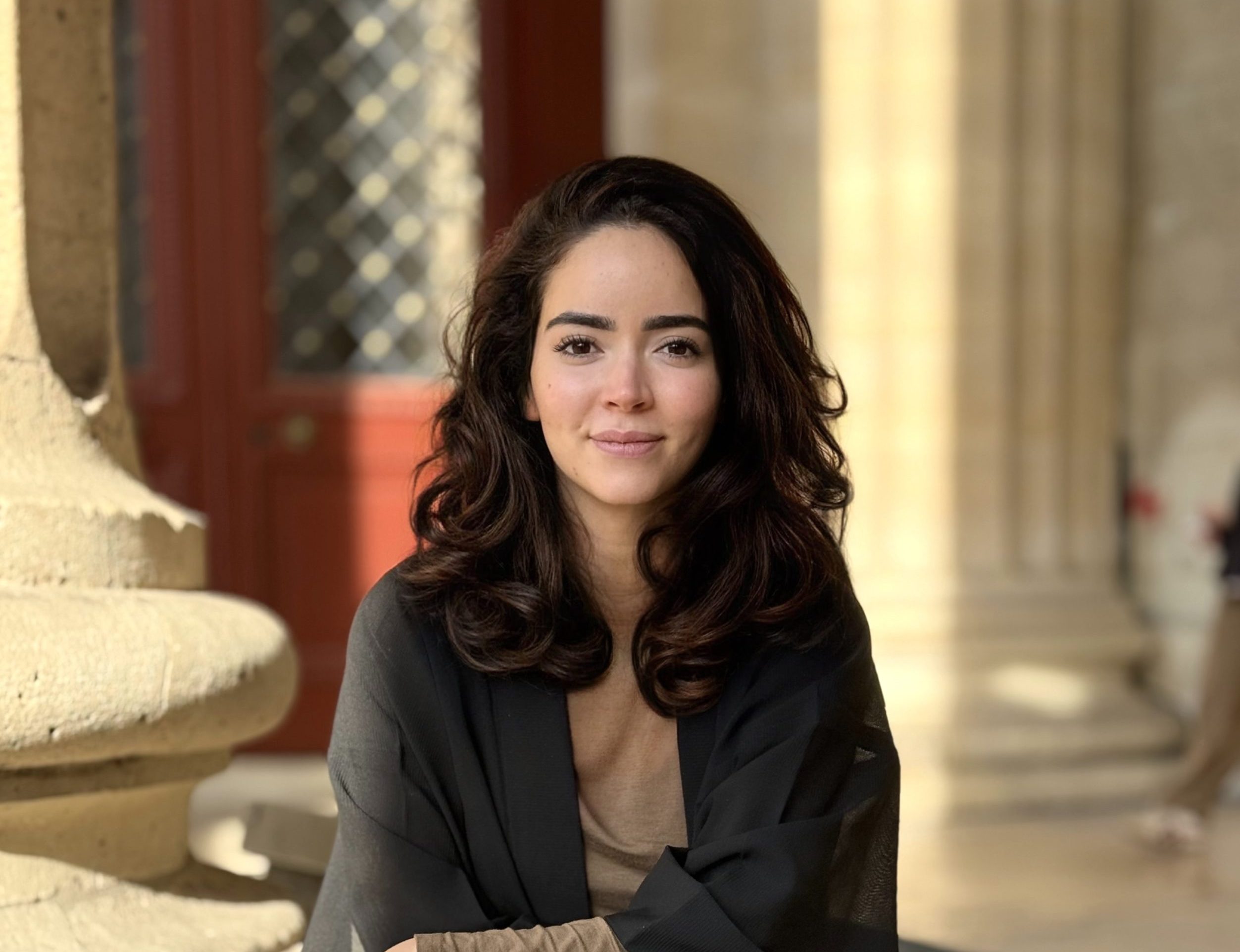
Asya Djoulaït
Modern Languages and Literature Teacher, Novelist, Actress
Spring 2027
- Literature
- New York

“Paris and New York are approached not simply as geographical spaces, but as living environments shaped by the words, accents, silences, and stories of those who inhabit them.”
While studying comparative literature in Lebanon, I discovered French-language writers who challenge the boundaries of “the” language.
I returned to France with a conviction: language should be a form of recreation for our tired lives.
At twenty, carried by this impulse, I wrote my first short story, inspired by the looting of Syrian antiquities at the beginning of the civil war. I received an award from the Sorbonne, which I saw as an invitation to continue writing.
At the same time, I taught French in secondary school. My students became my first readers of the world. Their ways of making the classics their own reminded me that literature survives only by changing perspectives. Yet one student told me, “There aren’t really many people like us in books, Miss.” This sentence became my literary starting point.
I write, in part, for them. I write about an age that is mistakenly perceived as carefree. I write to open up a space where their languages, imaginations, beliefs, and literary voices can exist, so that literature can remain a place of encounter with others and with oneself.
Asya Djoulaït is a recipient of the Prix du Jeune Écrivain. She published Noire précieuse (Gallimard), which was recognized by the Festival du Premier Roman, followed by Ibn (Grasset), selected by Le Monde as one of the best books of the year. After studying at the Cours Florent, she joined an international theatre company. She was also included in Vanity Fair’s cultural ranking of notable personalities under thirty.
Paris–New York Linguistic Atlas — Traveling Through the Languages of the City is an illustrated book for children. It offers a sensitive exploration of two major cities through their languages. Paris and New York are approached not simply as geographical spaces, but as living environments shaped by the words, accents, silences, and stories of those who inhabit them.
Each double-page spread brings a Parisian location into dialogue with its New York counterpart—subway stations, shopping streets, schools, parks, or apartment buildings—to show how languages shape urban landscapes and reveal the diversity of everyday experiences.
At the intersection of geography, sociolinguistics, and children’s literature, the atlas adopts a heterolingual approach attentive to the ordinary and hybrid forms of language. It moves beyond “official languages” to explore accents, urban writing, untranslatable words, spoken forms, slogans, graffiti, and public announcements. The city thus emerges as a polyphonic space where the visible and the audible intertwine.
The project is structured around a continuous dialogue between text and image. Composed of sensory maps and short narratives, it brings together children’s experiences, language games, and accessible insights into the phenomena of language contact.
At once an aesthetic object, a tool for discovery, and an invitation to curiosity, Paris–New York Linguistic Atlas reminds us that it is possible to travel simply by learning to listen to what is being said on the street corner.
I was invited to New York to lead writing workshops in schools. There, I discovered a city shaped as much by its sounds as by its forms, and animated by a diversity of languages that deeply inspired me.
The idea of approaching the city not only through its monuments or distances, but through the languages that inhabit it, lies at the heart of my research and writing. I think of the city as a space produced by voices, words, and linguistic exchanges. I explore these dynamics in my novels.
This experience between Paris and New York gave rise to the desire to develop a project connecting these two metropolises. Shaped by successive waves of migration, New York offers a particularly rich field for observing urban language practices, especially in neighborhoods such as Queens, Brooklyn, the Bronx, and Harlem, where languages, social histories, and musical cultures intertwine.
My project is grounded in field research based on observation, listening, and visual documentation of languages in the urban environment, in collaboration with schools, community organizations, and researchers in sociolinguistics and urban studies at NYU’s Sociolinguistics Lab.
In partnership with
Editions Gallimard
Éditions Gallimard, founded by Gaston Gallimard in 1911, is one of the leading French book publishers. Its catalog consists of 36 Prix Goncourt winners, 38 writers who have received the Nobel Prize in Literature, and ten writers who have been awarded the Pulitzer Prize.
Festival des Littératures Urbaines
The Urban Literature Festival is an event dedicated to contemporary narratives that explore the city and its realities, highlighting emerging voices and urban imaginaries that are often underrepresented in the literary landscape.