

Adeline Rapon
Photographer
February - May 2027
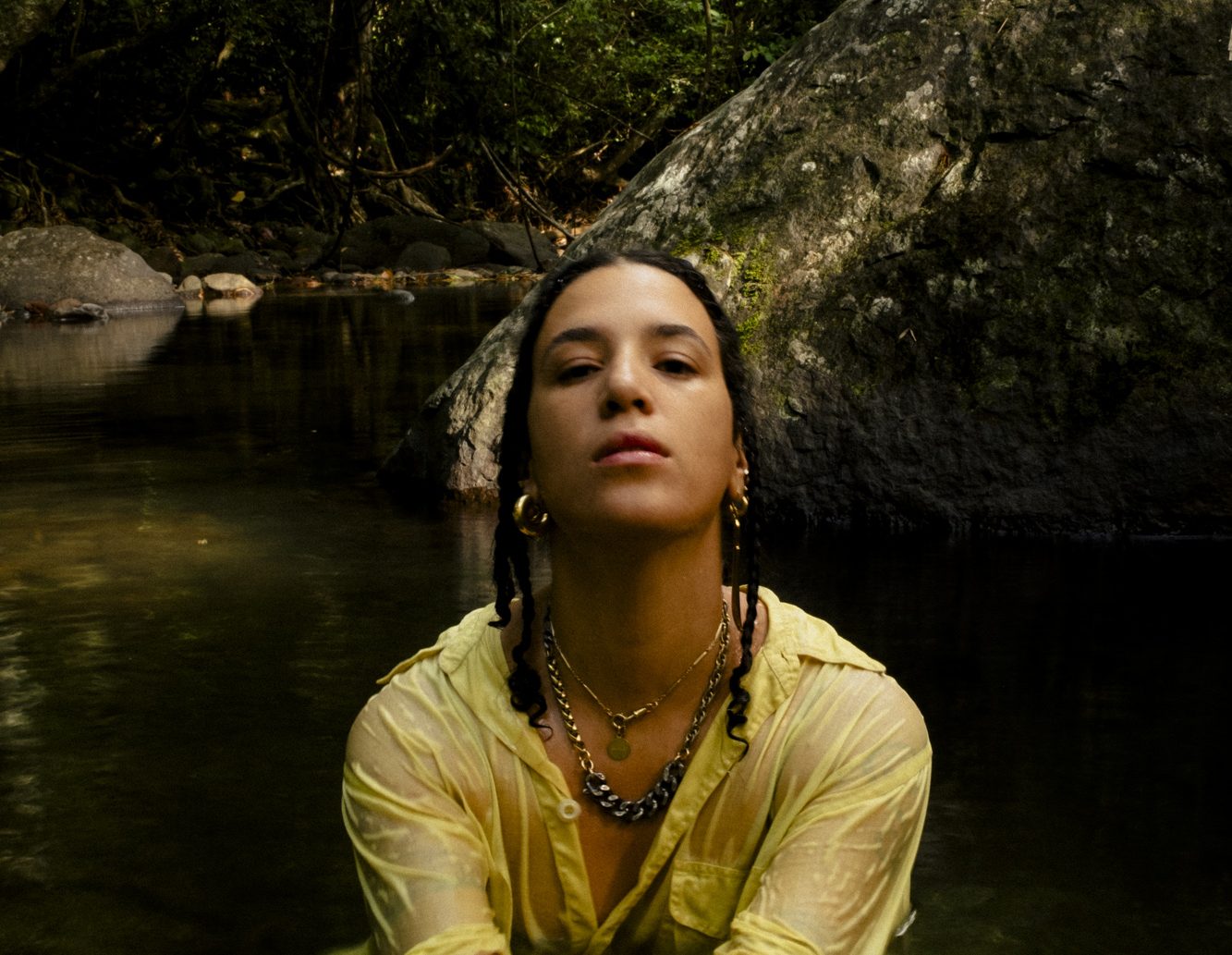
- Visual Arts
- Miami

“Miami is a Caribbean-American crossroads where diasporas coexist, where cultural inheritances circulate, resist, or disappear, and where segregation has shaped both the living and the dead. These dynamics resonate directly with those of Martinique, a territory that both inherits and perpetuates the legacy of the slave system.”
I am a Franco-Martinican artist and photographer based in Martinique, after spending my entire life in Paris. My practice draws on my intimate history, allowing me to explore the dynamics of mixed-race identity, cultural transmission, and the erasure caused by colonialism.
My artistic career began in 2020 with a series of self-portraits based on postcards depicting Caribbean women from the late nineteenth century: Pas si mal, n’est-ce pas notre petite créole? (Fanm Fò). As the project evolved, I was confronted with archives and the images they construct of our past.
Vie et Mort (2022) was my first project made in Martinique, and an initial step toward what has now become L’Oubli. In this work, I explored relationships with death, local All Saints’ Day traditions, and the conteur funéraire—a traditional storyteller associated with funerary practices—in search of disappearances and abandoned cemeteries.
In 2024, I decided to pursue my artistic and personal quest by moving to Martinique. There, I co-founded an LGBTQ+ initiative and began documenting events and moments of everyday life in a more direct way. From these new archives—which also involve an attempt to deconstruct my overly Western perspective—emerged Lien·s (2023) and Queeribéenne (2025).
2025 was also the year I was able to delve into my own memory and history through a month-long residency with Businenge sculptors and craftspeople. Having worked as a jeweler for ten years, I wanted to use this experience to enrich my practice with gestures and techniques passed down through my French-Corrèze family—woodworking, crochet, textiles—and to address the absence of such transmission on my Martinican side. That’s not fair… (2025) is an initial exploration of this hybridization, a rewriting of a past erased by forgetting.
Adeline Rapon is a self-taught Franco-Martinican photographer born in Paris in 1990. Her work has been exhibited at the Rencontres Photo du 10e in Paris (2021), at French Alliances in Brazil (2024–2026), at Tropiques Atrium Scène Nationale in Martinique (2025), and at Photo Hanoi 2025. In 2025, she participated in the Fotokontré program and exhibited the work resulting from her residency in Saint-Laurent-du-Maroni, French Guiana. Her fanzine Queeribéen·ne was published by Revers in 2025. She is a 2026 recipient of the Filles de la Photo mentorship program and a finalist for the 2026 Révélation SAIF x La Kabine Prize.
My father left Martinique to build his life in France, far from his culture. My grandfather, who stayed behind, had almost become a ghost. He died after years during which I was unable to see or contact him, and was buried in Gros-Morne. I was only able to visit his grave alone five years later, eighteen years after my last stay in Martinique.
This void is touched upon in my series Vie et Mort (2022). While searching for connections between the living and the dead in Martinique—through All Saints’ Day traditions and the conteur funéraire—I found only their disappearances. The cemeteries were deserted, and the gestures and rituals had been forgotten. How does the erasure of connections with our ancestors dispossess an identity that is already fragile? Since then, drawing on Surrealism, Afrofuturism, and the thought of Édouard Glissant, I have sought to fill this impossible-to-document void through fiction and material gestures.
Lincoln Memorial Park in Miami is a mirror of this history: the first cemetery dedicated to Black people in a city segregated even in death, it was abandoned for decades. One day, Jesse Wooden discovered that his mother was buried there. He subsequently bought the entire site and brought it back to life. Through this act of repair, he became a bridge between the present and ancestry.
It is this transversality that I seek to translate visually: what circulates between African diasporas, shared inheritances, and their erasures. I want to observe the process of reclaiming memory and understand how the mechanics of Forgetting have been reversed in this place.
I want to examine its archives, search for possible connections within the Brownsville neighborhood, and observe the renewed use of a place once thought to have been abandoned.
Miami is a Caribbean-American crossroads where diasporas coexist, where cultural inheritances circulate, resist, or disappear, and where segregation has shaped both the living and the dead. These dynamics resonate directly with those of Martinique, a territory that both inherits and perpetuates the legacy of the slave system.
The project began to take shape when I met Jesse Wooden during my visit to the WOPHA Festival in 2024. The owner and manager of Lincoln Memorial Park Cemetery, he invited me to return. I would like to work alongside him, observe the cemetery’s daily operations, and examine its archival records.
In Coconut Grove, Charlotte Jane Memorial Park is another point of reference: a cemetery belonging to the Bahamian community, it bears traces of a Caribbean diaspora and its funerary practices on American soil. In Overtown, the Hampton House—a 1950s hotel where Black people could stay in a segregated city—is another site of memory that I would like to explore. I also hope to meet artists, researchers, and cultural memory-keepers whose practices are rooted in this history.
Martinique is a small territory where opportunities for triangulation are limited. Miami offers a perspective through the diaspora that the island alone cannot provide, as well as the opportunity to work at the heart of a city where Black and Caribbean memory is both buried and alive. It is from this distance that I seek to understand what Forgetting has done to us, and what we might be able to do with it.
In partnership with
La Station Culturelle
La Station Culturelle is a contemporary art organization and art center based in Fort-de-France, Martinique, supporting and promoting emerging contemporary artists through exhibitions, residencies, public programs, and professional development initiatives. It also develops projects across the Caribbean and internationally.
Women Photographers International Archive (WOPHA)
Women Photographers International Archive (WOPHA) is a Miami-based nonprofit organization dedicated to researching, promoting, and supporting women and non-binary photographers through archives, exhibitions, publications, research programs, residencies, and educational initiatives.