

TILT
Artist
May - June 2027
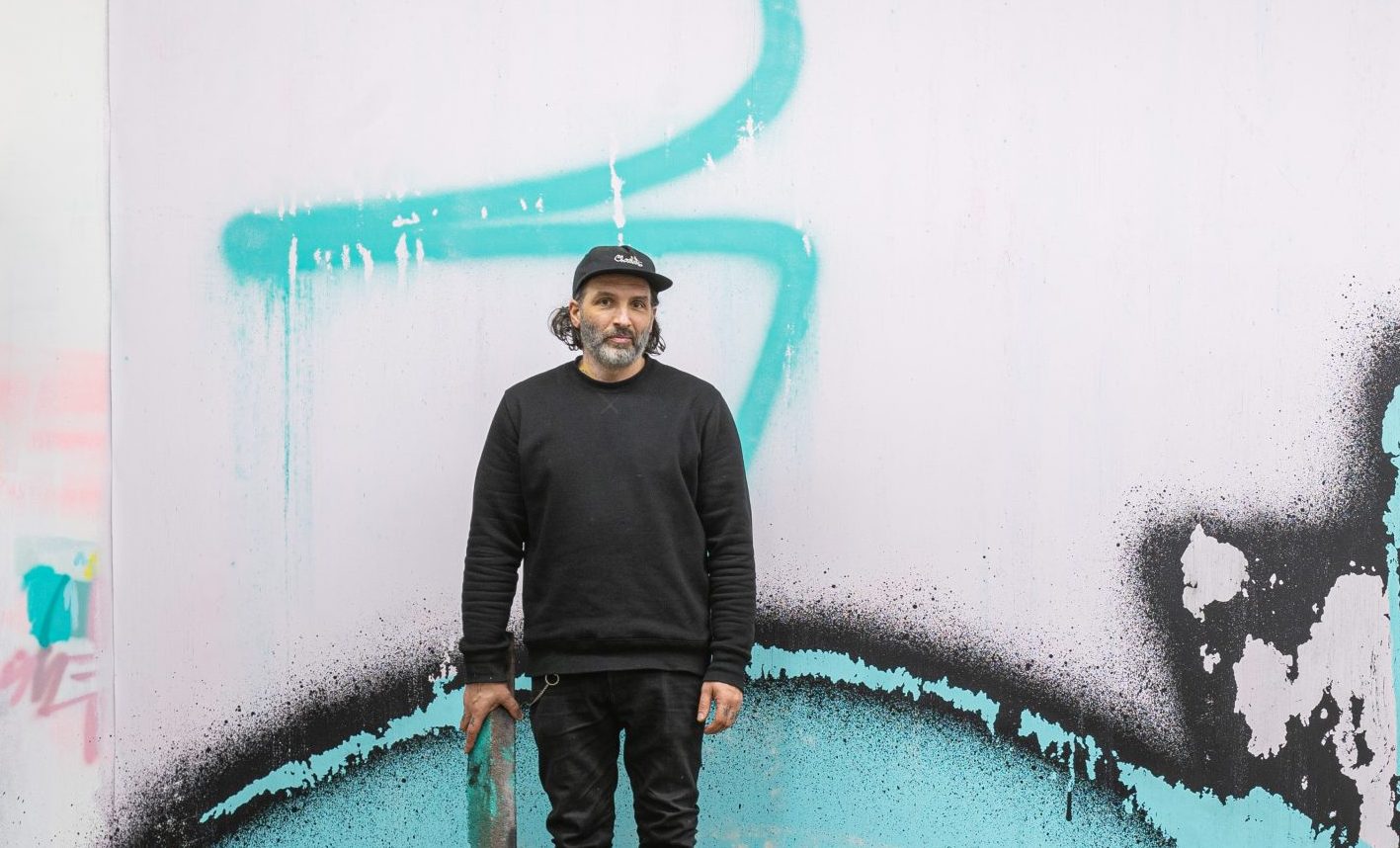
- Visual Arts
- Atlanta

“The approach could be understood as an archaeology of contemporaneity, bringing to light different strata and moments, as well as superimposed images that reveal the city’s memory in the form of palimpsests.”
Since the late 1980s, my work has grown out of a passion for painting—both for the freedom and unruliness of the graffiti-writing tradition, and for the legacies of “great” painting and my admiration for Robert Motherwell, Martin Barré, and Gerhard Richter. I therefore identify, at least in part, with a current now described as “post-vandalism,” continuing to use the same signature—TILT—for my studio work and for the work through which I am known as a graffiti artist.
The idea of “décoïncidence,” or non-coincidence, could encapsulate the essence of my approach.
For several years, I have been creating assemblages that bring together several paintings on canvas or on a variety of supports—painted objects. These fragments depict details of graffiti reproduced in the studio from photographic records made in urban spaces around the world, either at a 1:1 scale or greatly enlarged.
These disruptive marquetry-like compositions seem to reflect the banality of our urban spaces, in which heterogeneous images and objects collide, producing the very aesthetic of everyday life.
I seek to transpose into painting the tensions between margins and centers, intimacy and the mainstream, authority and resistance, construction and destruction, because walls preserve every trace, even through erasure and ruin. For instance, in installations in Marrakech and Rouen, I have sought to show, simultaneously, vandalized places violently overexposed to light and chromatic variations in painting that multiply the beauty of the everyday and of detail.
Tilt has developed a graffiti practice since the late 1980s alongside a studio-based body of work. He has taken part in numerous solo and group exhibitions in France and internationally. He has been invited to undertake residencies in Chongqing (Tank Loft Art Institute / Musée des Abattoirs, Toulouse) and Marrakech (Fondation Montresso), and has participated in the Marrakech Biennale of Contemporary Art, exhibitions at the Mohammed VI Museum of Modern and Contemporary Art in Rabat, and Art Genève. His work has been the subject of several publications and monographic videos, and is held in public and private collections as well as in public space. In 2018, he received the Promesses prize at the twentieth edition of Art Paris Art Fair at the Grand Palais in Paris.
I plan to document traces that tell the story of a city—Atlanta—from the early 1980s to its present-day configurations. For several years, I have been making photographic records in urban spaces of graffiti traces—more specifically, spray-painted lettering—as well as of the cleaning operations that have led to their erasure. I have become particularly interested in the aesthetic value of these “cleanings,” which transform the initial graffiti paintings into abstract pictorial surfaces with formal values of their own.
This project therefore follows on from earlier work that has enabled me to confirm the relevance of this approach at the scale of a street or a neighborhood. Extending this practice to the scale of an international metropolis such as Atlanta represents another ambition. The aim is to map the city’s occupation, transformations, shifts in its activity zones, the redistribution of centers and peripheries, and its lines of force and fragility, transition and collision.
The approach could be understood as an archaeology of contemporaneity, bringing to light different strata and moments, as well as superimposed images that reveal the city’s memory in the form of palimpsests.
I am especially concerned with urban-planning issues in their social and cultural dimensions, and I intend to involve as many relevant stakeholders as possible in this inquiry. Photographic and video records, documentary research, and encounters will make the method both personal and participatory.
The project may result in several forms of presentation: an exhibition of paintings made in the studio from these records; an exhibition of photographs taken in situ; video screenings; talks; and more.
This residency at Villa Albertine in Atlanta will provide a tremendous opportunity to devote sustained time to carrying out this ambitious project and to consider how it might subsequently be presented in France, within the framework of the transatlantic exchanges long initiated by the city.
I have stayed in the United States several times—in New York, California, and Florida. I also had the opportunity to discover Atlanta in 2012, when I created a monumental mural for the Elevate Festival at the invitation of the Office of Cultural Affairs, as part of a twinning agreement with my hometown of Toulouse. I returned in 2024, for the mural’s fiftieth anniversary, to restore it.
I was able to see firsthand the strong attachment residents still have to this painting in a neighborhood that has remained almost unchanged, as well as the impact it has had on younger generations. I am therefore all the more enthusiastic about renewing my dialogue with the city in order to develop an ambitious new project connected to my more recent artistic practice.
I am drawn to both Atlanta’s history and its present-day reality. A key site in the emergence of the civil-rights movement in the United States, the city is also at the forefront of gentrification, which is profoundly transforming its habits, social fabric, and ways of life. Atlanta is, above all, a city whose walls allow us to read its history: traces of earlier graffiti remain; their erasure has created new marks, often close to abstract painting; and new inscriptions now punctuate public spaces.
This is what I observed during my recent stay in Atlanta in 2024, when my initial photographic explorations revealed the scale and relevance of a vast archaeological site of the contemporary.
In partnership with
Mairie de Toulouse
Musée des Beaux-Arts de Rouen
The Musée des Beaux-Arts de Rouen houses one of France’s most prestigious public art collections. Founded in 1801, it brings together paintings, sculptures, drawings, and decorative arts from the fifteenth century to the present day, including major works by Caravaggio, Rubens, Velázquez, Poussin, Géricault, Monet, and Modigliani.
Lieu-Commun
Lieu-Commun is an independent space for contemporary art production and presentation, founded in Toulouse in 2007. Housed in a former 1,000-square-metre shirt factory in the Bonnefoy district, it brings together exhibition spaces, artists’ studios, a sound-recording studio, and an artist residency apartment.