

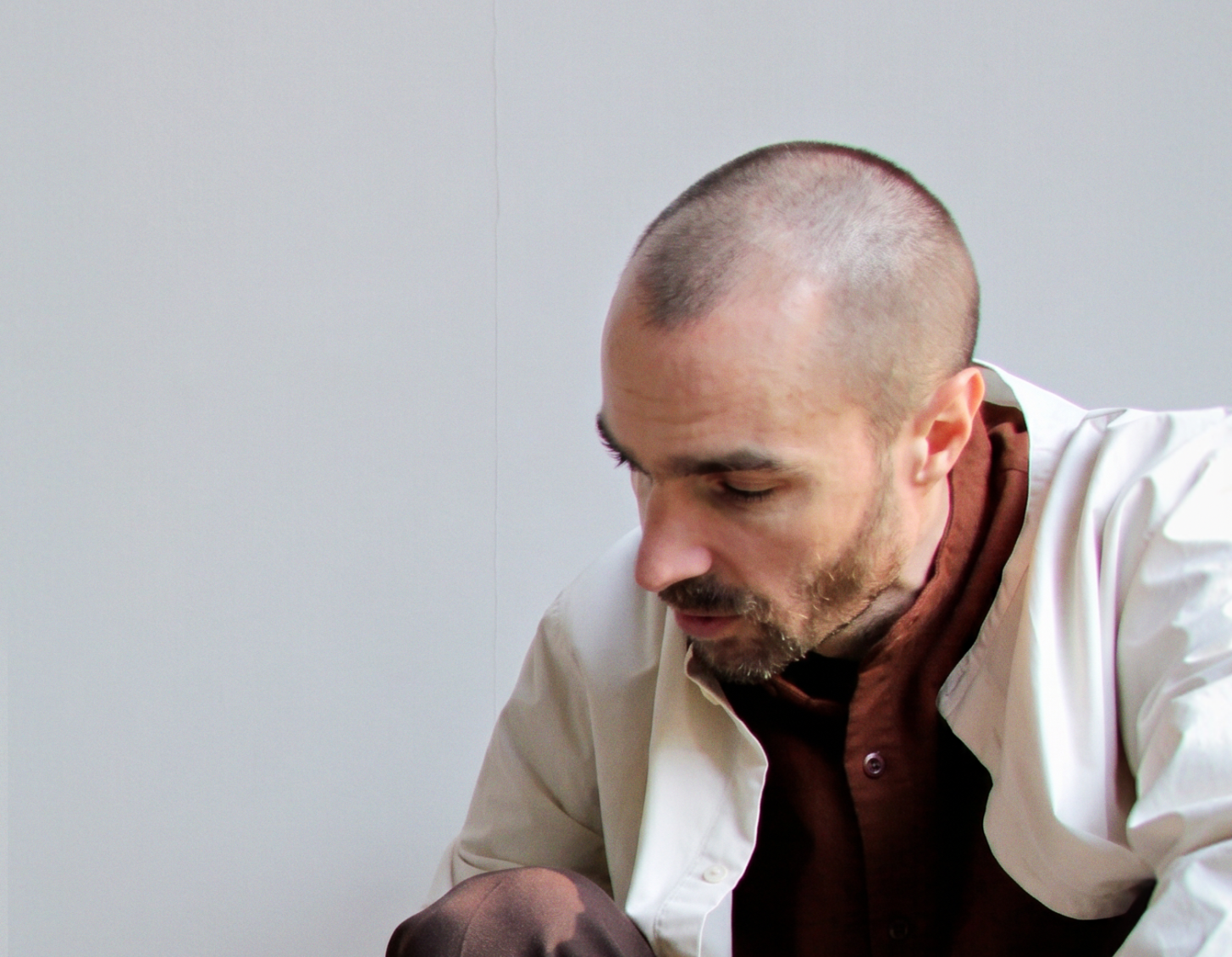
Simon Rouby
Filmmaker
Spring 2027
- Cinema
- Miami

“Each summer, an atmospheric river carries hundreds of millions of tons of Saharan dust across the Atlantic, over a distance of some eight thousand kilometers. “Lithometeors” takes this meteorological fact as a starting point from which to unfold its different symbolic strata.”
In cities across France, car windshields are regularly covered in a fine ochre dust: sand from the Sahara, carried thousands of kilometers by the wind.
As a child, I saw in it the irruption of a distant world. This experience has shaped my work as a filmmaker and visual artist, largely devoted to the ties between the African continent and France. My first animated feature, Adama, subtitled The World of Winds, already turned this dust into a visual metaphor for displacement and migration.
Since then, I have developed a practice in which animation, projection, and installation enter into dialogue with dance and music. With artist Native Maqari, I have been conducting long-term research in northern Nigeria since 2018. In the United States, I have had the opportunity to explore questions of diasporic memory through the work of choreographer Onye Ozuzu.
Through this research, I recently discovered the name—both scientific and poetic—given to these particles of sand: lithometeors, and more specifically the Saharan Air Layer (SAL), an atmospheric river of dust that crosses the Atlantic every summer. This phenomenon gave rise to a documentary project in which Saharan dust becomes at once a scientific fact, a story of resilience, and a metaphor for displacement.
Ce paragraphe sera suivi d’une courte biographie, plus formelle, indiquée en italique. Vous pouvez indiquer notamment les prix que vous avez reçus, les œuvres réalisées, ou toute information non mentionnée ci-avant. Merci de proposer un texte de 50 à 100 mots rédigé à la 3ème personne.
Simon Rouby is a filmmaker and visual artist. Having come to cinema frame by frame, he directed his first animated feature, Adama, in 2015; the film was selected for the César Awards and the European Film Awards. He studied at Les Gobelins in Paris, CalArts in Los Angeles, and the Villa Medici in Rome. His transdisciplinary practice engages with visual arts and performance, notably through Almajir, co-created with Native Maqari and presented at the Centre Pompidou in 2021.
Each summer, the Saharan Air Layer carries hundreds of millions of tons of Saharan dust across the Atlantic, over a distance of some eight thousand kilometers. Lithometeors takes this meteorological fact as a starting point from which to unfold its different symbolic strata.
Scientifically, this dry, dust-laden layer of air suppresses the formation of Atlantic hurricanes, paradoxically making South Florida more livable. The dust both protects and fertilizes: its phosphorus travels as far as the Amazon rainforest, where it helps replenish nutrients. In Miami, I will follow scientists from NOAA’s Hurricane Research Division (National Oceanic and Atmospheric Administration), in particular Dr. Jason Dunion, who has been tracking this phenomenon for two decades.
Historically, the SAL retraces the routes of the Middle Passage. Puerto Rican scholar Yarimar Bonilla reads it as a diaspora of sorts: “displaced grains of sand lifted up by the dry winds and forced into exile from the desert. Almost imperceivable in their individuality, these little specks of dust register only in their perseverance to stay together even as they are forced into far-flung lands.”
This metaphor echoes Onye Ozuzu’s work in her performance Space Carcasses, for which I am the filmmaker. In the piece, she explores how the body extends beyond its own limits into the architecture of the Black Atlantic. Buildings become a living matter that accumulates memory and is worn like a skin.
In this process, Native Maqari, whose family roots lie in the Sahel, proposed a shift from architecture to the SAL itself, understood as a structure held in suspension. This intuition led Onye to expand her inquiry to a planetary scale: a form of proprioception extending from the body to the building, and from the building to the Earth, with the atmosphere understood as a shared container.
The final work will be multiple and collaborative: a documentary essay, an installation, and a performance.
Miami is the North American landfall of the Saharan Air Layer’s eight-thousand-kilometer journey, and one of the places where it is most closely studied. On Virginia Key, NOAA conducts world-leading research, including by flying “hurricane hunter” aircraft into the heart of dust plumes.
Miami is home to some of the largest Caribbean and Latin American communities in the United States—including Haitian, Dominican, Jamaican, and Puerto Rican communities—whose ancestral routes overlap with those of the SAL. In Little Haiti, Overtown, and Liberty City, I will reach out to residents and listen to what this phenomenon evokes for them, echoing research already underway around the Harmattan in northern Nigeria.
Like dust itself, I am seeking less a demonstration than a sedimentation of stories. The residency will, I hope, be a time in which layers accumulate—interviews, scientific data, footage of the phenomenon—and my subject will no doubt shift as I follow it.
Onye Ozuzu lives in northern Florida. Together, we plan to widen our radius and also film in Savannah, St. Augustine, and Jekyll Island, as well as in San Juan, Puerto Rico, where the SAL’s manifestations are woven into daily life.
In partnership with

Centre Pompidou
Since 1977, the Centre Pompidou has presented a rich programme at the crossroads between different art forms and audiences. Its iconic building is home to one of the world’s largest modern and contemporary art collections, in addition to exhibitions, symposiums, festivals, shows, projections, and workshops for young audiences, making it an unparalleled cultural institution, deeply rooted in the cultural fabric of Paris and open to the world and to new innovation.

Miyu Productions
Miyu Productions is a French film and audiovisual production company specializing in animation. Founded in 2009, it produces short films, series, and feature films, with a strong artistic focus and a particular commitment to independent animation.

OzuzuDances
OzuzuDances is a U.S.-based artistic platform led by choreographer and performance artist Onye Ozuzu. Her transdisciplinary practice explores the intersections of diasporic movement traditions, improvisation, and experimental performance, positioning the body as a site of memory, transmission, and transformation.