
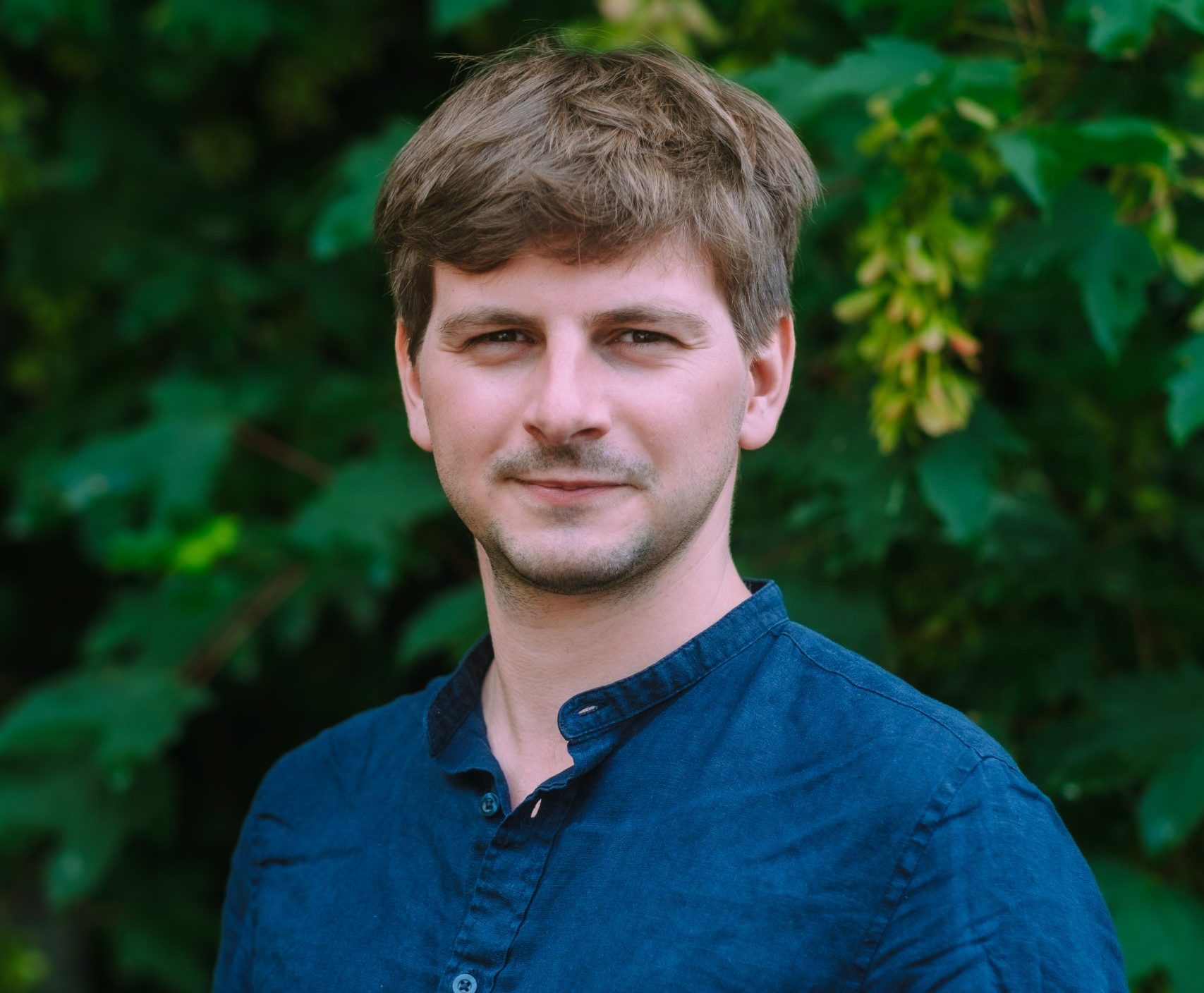
Romain Weber
Writer
March-May 2027
- Literature
- Chicago

“Korczak Ziolkowski spent his life sculpting Crazy Horse into a mountain in South Dakota. He had returned from war, and before that, from Mount Rushmore. Orphaned at the age of one, art became his therapy, and his work had to match the scale of his wounds: monumental. His life deserves a novel.”
I am a writer for France Inter and France Culture, where I seek to tell stories from the past in an attempt to shed light on the present—and to experience the singular pleasure of constructing a story.
I am one of the writers of Affaires Sensibles, a daily one-hour program on France Inter devoted to stories drawn from recent history. Criminal cases, political affairs, major cultural events… From the Dreyfus Affair to Algeria’s 2019 revolution, I have written numerous stories, notably about the Occupation and the French far right.
At France Culture, documentaries, and particularly the Grandes Traversées series, allow me to tell longer stories about figures from contemporary history: Jean Moulin and his legend, in 2023; then Malcolm X and his anger, in the summer of 2025. And because we sometimes wish we had a better grasp on the course of reality, I also write radio fiction for France Culture. My most recent work, AfficheTonEx, tells the story of revenge porn, its devastating effects, and the women fighting against it.
My interests have gradually converged toward the United States. Malcolm X, Bonnie and Clyde, Standing Rock’s fight against the pipeline, the writing of In Cold Blood… It is therefore quite naturally that I want to write my first book about a subject deeply rooted in American territory: a fictionalized biography of a man who spent forty years of his life bringing the face of the great Sioux leader Crazy Horse out of a mountain in South Dakota. His name was Korczak Ziolkowski, and he pursued the unusual—and megalomaniacal—profession of mountain sculptor.
Romain Weber is a writer for French public radio. He graduated from Sciences Po in 2018 and lives in Paris. For France Inter, he has written eighty episodes of Affaires Sensibles and co-written the series Xi Jinping, le prince rouge.
For France Culture, he has written twenty documentaries for Une Histoire Particulière, Toute Une Vie, and Les Grandes Traversées (Jean Moulin, un Français libre; Malcolm X, colère noire).
In 2019, he was awarded the France Culture / SACD Native Podcasts Fund for his fiction series Les disparus de Bas-Vourlans, which was nominated for the 2021 Prix Europa. In 2025, he co-created AfficheTonEx with journalist Constance Vilanova, a series nominated for the 2025 Prix Italia.
Thirty kilometers from Mount Rushmore stands another sculpted mountain. It faces Mount Rushmore, answering it in a sense. Deep in the Black Hills of South Dakota, it can be seen from afar: it is the monumental likeness of the Sioux leader Crazy Horse. His face alone is 27 meters high. The work is the creation of sculptor Korczak Ziolkowski. He had no money, but he had all the time in the world. He sculpted the mountain for forty years, until his death. There is a novel waiting to be written here.
The 74 years of Korczak Ziolkowski’s life are marked by disproportion: the disproportion of suffering, ego, and artistic achievement. Orphaned at the age of one and severely abused by his foster families, he later became the father of ten children and the creator of what is intended to become the largest sculpture in the world. Ziolkowski found himself caught in the folds of the history of the Indian Wars, whose sorrow may, perhaps, have felt familiar to him. Exceptionally gifted as a sculptor, he worked on the great artistic undertaking of his time: Mount Rushmore. And he was proud of it—Korczak, very proud. Yet the faces of Washington, Jefferson, Roosevelt, and Lincoln were carved into the sacred lands of the Sioux. So Chief Henry Standing Bear proposed an adventure to him: to sculpt another mountain, even larger this time, in the image of Crazy Horse.
Korczak Ziolkowski accepted. Because, as he put it, “a very big mountain requires a very big ego.” But also because between these two chapters of his life—Mount Rushmore and Crazy Horse—there lies another, ghostly and mysterious one: the war. In 1944–45, from Omaha Beach through the final stages of the liberation of Europe, Korczak Ziolkowski descended into the heart of darkness. What did he experience there that led him to devote his life to a mountain in South Dakota, sculpting it until he could no longer continue?
Korczak Ziolkowski’s work is embedded in the Black Hills. So is his life. To understand his personality, I need to go there.
First, conveying the sheer scale of Mount Rushmore and the Crazy Horse Memorial as vividly as possible requires being there and experiencing these places in their physical dimensions and surroundings.
Second, the Crazy Horse Memorial is now a nonprofit organization holding a vast collection of Korczak Ziolkowski’s archives: many of his sculptures, personal documents, records of the project’s history, the techniques and processes he used to sculpt the mountain, and much more.
The Black Hills are also where most of his children still live, as well as many of the men and women who knew him. To write this book, I need to speak with them and establish a connection that can only be created through a physical encounter. Telling the story of one’s father or friend, opening one’s heart and memory to a stranger, is difficult; it requires time.
But Korczak Ziolkowski’s story is also the story of the Sioux people. Writing this book means gaining an intimate understanding of their history and apprehending what figures such as Crazy Horse and Sitting Bull mean today. This residency will also be an opportunity to understand for myself a past that continues to inhabit the United States.
In partnership with
Éditions Rivages
Rivages Editions was founded in 1984, and publishes mainly fiction: French and foreign literature, thrillers and detective stories, graphic novels and fantasy/SF. For some years now, we have also been publishing humanities texts in the Bibliothèque Rivages and Petite Bibliothèque Rivages collections.