

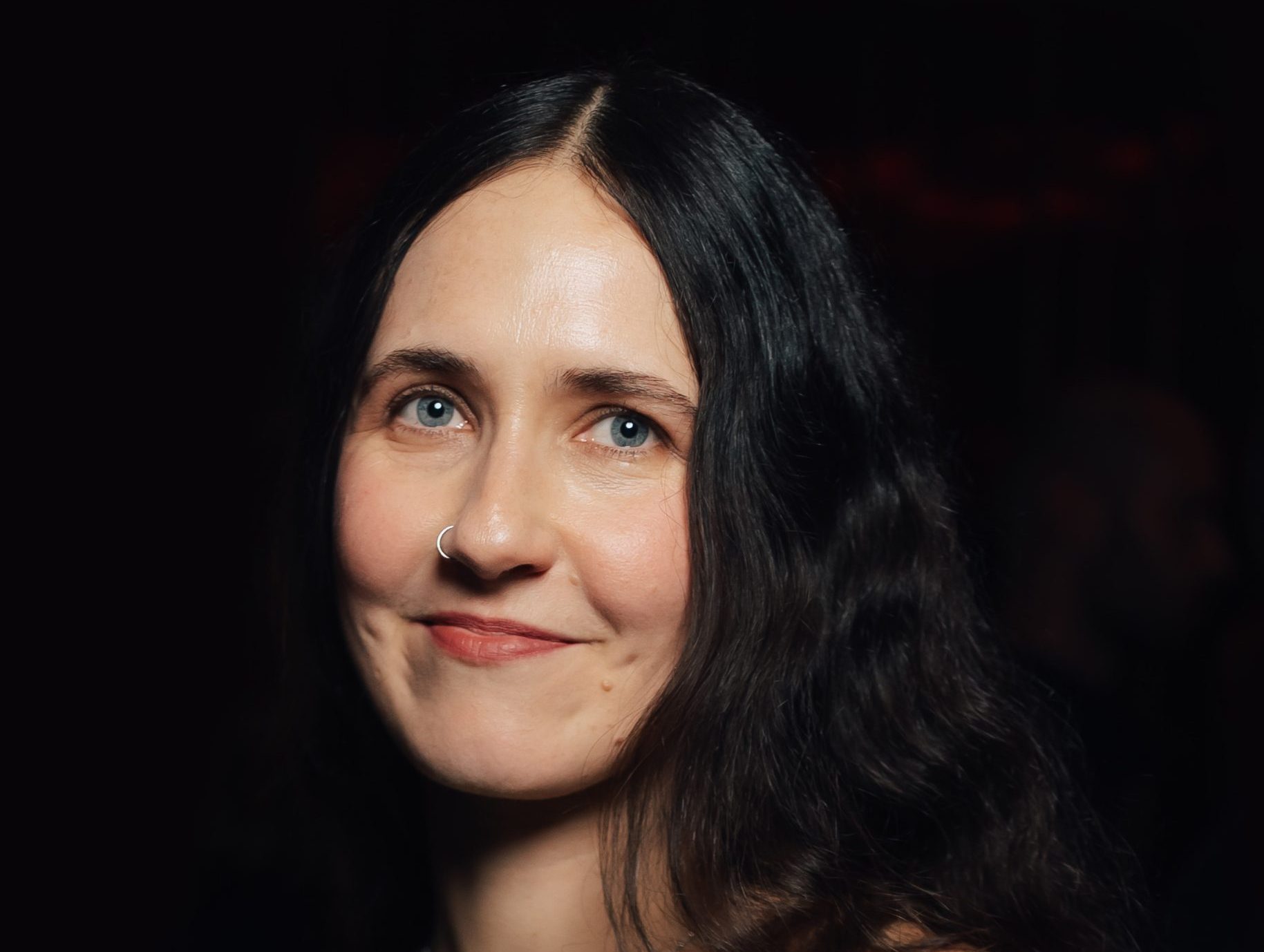
Clara Daguin
Artist in computational couture
Fall 2027
- Craft & Design
- Los Angeles
- San Francisco


“This residency comes at a pivotal moment for the Métiers d’Art: the mechanical gesture is being redefined by Artificial Intelligence with the emergence of Brain-Machine Interfaces (BMIs) in the United States—specifically those utilizing robotic “sewing machines” to insert electrodes into the brain.”
My interest in the exploration of how technology affects and interacts with the body, our reliance on it and its growing omnipresence dates back to 2012, when I began medical treatment through a connected device. I decided that I would use the body as a canvas to explore the way technology changes our perception of ourselves in an increasingly connected world.
I consider myself an artist, working at the intersection of technological savoir-faire and fashion design. My practice is rooted in the intelligence of the hand and the dialogue between the tradition of craft and the invisible currents of technology. Growing up in the Silicon Valley and being trained in Paris, I occupy a unique position between two heritages, and embody a Franco-American culture and point of view.
At the heart of my work is light, which I use as a material to interpret energies and flows, revealing what is invisible. In each of my pieces, the textile is crafted to integrate electronics, creating a living interface – an augmented and interactive second skin endowed with luminescent movement – connecting technological finesse with the rigor of Haute-Couture.
Each collection and special project is an opportunity to explore new techniques, experiment with materials and create novel interactions. This residency will be a unique moment of inspiration research – digging deeper into questions about how we endeavor to augment our bodies and minds, the range of hacking techniques at our disposal today, and the projects being elaborated for the near future.
Clara Daguin is a French-born artist who grew up in California’s Silicon Valley. She is a graduate of CCA (San Francisco), ENSAD (Paris) and a 2016 finalist of the renowned Festival International de Mode et Photographie in Hyères. She collaborates with artists, researchers and institutions including Google, Baccarat, Nike.
In 2025 she was knighted Chevalière dans l’Ordre des Arts et des Lettres. In 2023 she won the Grand Prix de la Création de la Ville de Paris (Fashion), and the Prix de l’Innovation. In 2024, she dressed Juliette Armanet and Sofiane Pamart for the opening ceremony of the Olympic Games.
The Augmented Gesture.
From the Embroidery Needle to the Neural Stitch: A Cross-Disciplinary Study of Precision and Craft
This residency comes at a pivotal moment for the Métiers d’Art: the mechanical gesture is being redefined by Artificial Intelligence with the emergence of Brain-Machine Interfaces (BMIs) in the United States—specifically those utilizing robotic “sewing machines” to insert electrodes into the brain. I believe that for embroidery to remain a living craft, it must engage with the most advanced needles of our time—those found in neuro-robotics.
Traditionally, a suture is meant to be static—it holds things together until they heal. In the age of AI, the thread is “alive” with data. My work has always been about invisible signals. This residency is the logical next step: moving from signals on the skin to signals in the mind. How do we visualize a stitch that isn’t just a line on a garment, but a highway for thoughts? Is it possible to imagine a shift from “Body as Canvas” to “Brain as Controller”: a garment where the light patterns aren’t just reflecting your pulse or movement, but are being intentionally “painted” by your thoughts via a Brain-Machine Interface?
Through the study of these developing technologies, I seek to understand how a manual craft like sewing is being transformed into an almost transhumanist tool. I intend to produce a visual manifesto titled Le Geste Augmenté. This will demonstrate how the Métiers d’Art are not static traditions but are the very foundation upon which our future technological interfaces are being built.
While Europe excels in the preservation of savoir-faire, the United States is the theater where the post-human body is being designed. California is a premier location for this residency because it functions as the global capital of human-machine performance.
While Silicon Valley builds the back-end of AI, LA is where that technology is applied directly to the entertainment, luxury wellness, and transhumanist industries. Los Angeles offers a unique convergence: the high-precision craft of Hollywood’s costume legacy and the pioneering brain-machine interface (BMI) research at UCLA and USC. My project necessitates immersion in these American labs to observe a new kind of ’embroidery’: the surgical, AI-guided stitching of neural threads. I am not seeking to replace the hand, but to understand how the artisan’s hand has inspired algorithmic precision.
This residency represents a critical evolution in my practice. Having previously collaborated with Google and created custom work for exhibitions and brands, I have proven that interactive textiles can bridge the digital and physical. However, this stay will allow me to transition from ‘wearable tech’ to ‘cognitive craft.’ I intend to establish a dialogue with institutions, companies, and local communities which will provide the philosophical soil and technical expertise needed for this critical inquiry. Some examples are The USC Brain and Creativity Institute (BCI), biohackers who are early adopters of AI-integrated implants and wearables, the wellness and transhumanist communities, and companies such as Neuralink who are actively testing neurosurgical techniques.
I aim to return to France with a renewed vocabulary of gestures that reflect our era’s complexity.
In partnership with

Google France
Google France develops technologies and AI-powered solutions to foster innovation and support businesses and society, while contributing to the global reach of French culture.

EnsadLab

Fondation Bettencourt Schueller
As a family foundation and a public-interest foundation at the same time, the Fondation Bettencourt Schueller has chosen to “take talents to the top” to contribute to France’s success and influence.
To this end, the Foundation seeks, selects, supports and promotes women and men who are rethinking our future in three fields that make a tangible difference to the common good: life sciences, the arts and an inclusive society.
With a philanthropic mindset, the foundation takes action through prizes, donations, personalized support, effective communication and co-created initiatives.
Since the foundation was founded in 1987, it has awarded prizes to 676 laureates and supported more than 1,400 projects led by talented individuals, teams, associations and organizations.
For more information: www.fondationbs.org/en | Instagram: @fondationbettencourtschueller | Facebook: @BettencourtSchuellerFoundation