

CMA CGM Becomes Founding Patron of Villa Albertine’s Lafayette Fellowship and Welcomes Its First Cohort to Marseille
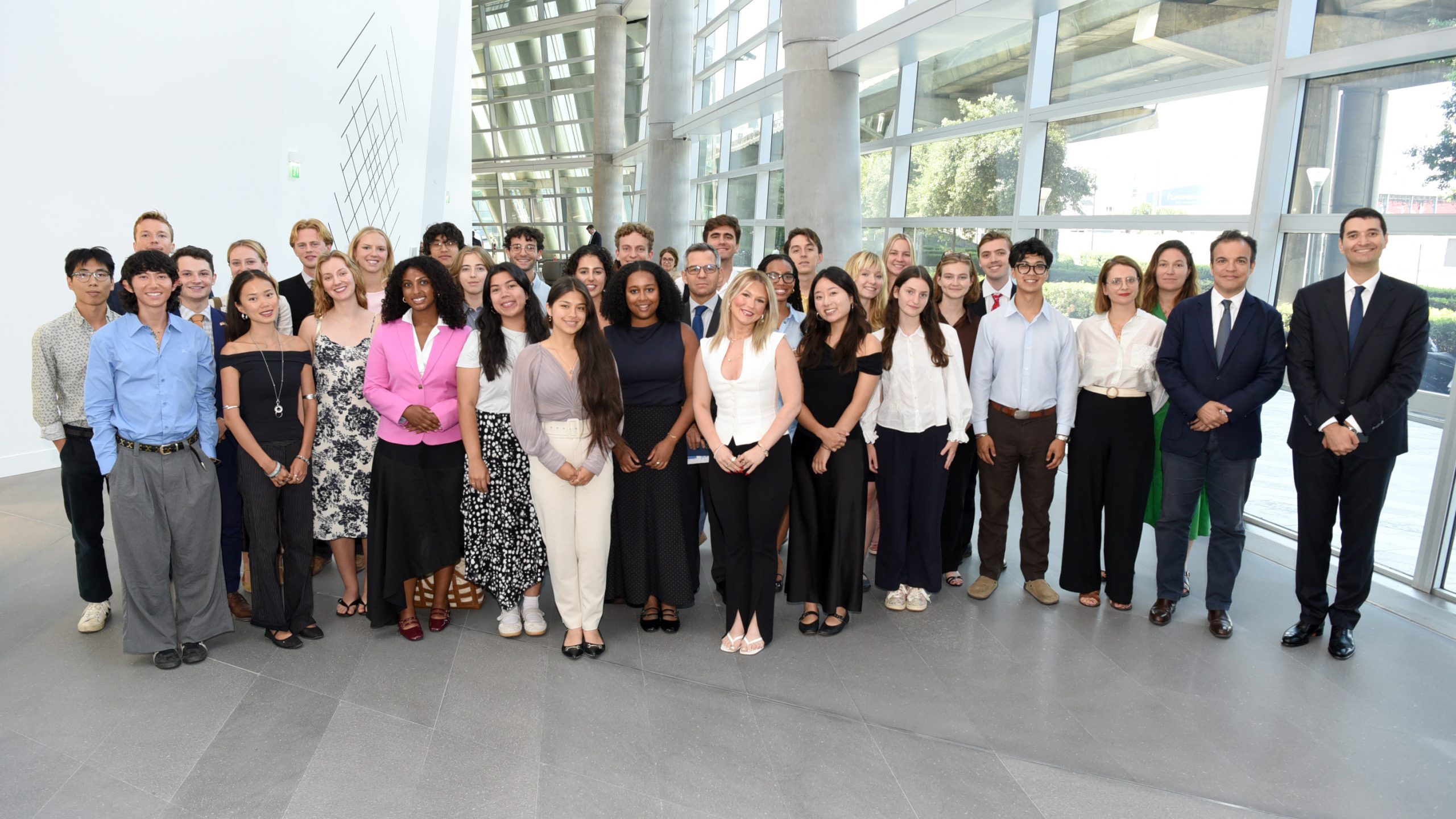
Marseille, July 23, 2026 — As part of their orientation program in France, the inaugural cohort of 30 Lafayette Fellows was welcomed to CMA CGM’s headquarters in Marseille on Thursday, July 23.
Created by Villa Albertine—the French Institute for Culture and Education of the French Embassy in the United States—in partnership with France Science and with the support of Albertine Foundation, the Lafayette Fellowship aims to cultivate a new generation of American leaders committed to the future of the relationship between France and the United States.
Selected from more than 3,400 applicants from leading U.S. universities, the Fellows will begin master’s degree programs this fall at 15 of France’s foremost higher education institutions.
Alongside their academic studies, the Fellows will take part throughout the year in a Leadership Program combining mentorship, meetings with leaders across the public and private sectors, and institutional, scientific, and cultural visits across France. Upon completing the program, they will join an alumni community designed to foster a lasting network of American leaders dedicated to strengthening the relationship between France and the U.S.
The Lafayette Fellowship Endowment Fund was established to secure the program’s long-term financial sustainability. CMA CGM’s founding commitment forms the cornerstone of the Fund and represents a major first step toward securing the Fellowship’s future.
Supporting the Next Generation of Talent
For CMA CGM, supporting the Lafayette Fellowship reflects a long-term commitment to talent, education, and Franco-American cooperation. As the leading French employer in the United States in the maritime and logistics sectors, the Group has significantly expanded its transatlantic presence in recent years, investing tens of billions of dollars in infrastructure, logistics, maritime shipping, and air freight.
As a founding patron of the Lafayette Fellowship Endowment Fund, CMA CGM is offering the inaugural cohort an immersive experience at TANGRAM, the Group’s innovation and training center in Marseille. The Fellows also visited the CMA CGM Foundation’s Solidarity Warehouse, a social-innovation initiative that draws on the Group’s logistics expertise to support humanitarian action. Throughout the visit, the students met with CMA CGM executives and experts. This experience reflects the distinctive model of the Lafayette Fellowship, which combines academic excellence, leadership development, and direct engagement with leading French institutions and companies. It also marks the beginning of a long-term partnership between CMA CGM and Villa Albertine around the Lafayette Fellowship.
Through its support for the program, CMA CGM is reaffirming its commitment to strengthening the enduring relationship between France and the United States by fostering academic, scientific, economic, and cultural exchange.
During the visit, Angelo Mikael, Vice President for Talent Development and Training and Chief Executive Officer of TANGRAM, said: “Attracting, developing, and supporting the best talent lies at the heart of Rodolphe Saadé’s growth strategy for the CMA CGM Group. As a founding patron of the Lafayette Fellowship, we hope to give an outstanding new generation of American students the opportunity to experience France firsthand, discover its higher education system, and engage with its innovation ecosystem. In doing so, we aim to help strengthen the enduring ties between France and the United States.”
Mohamed Bouabdallah, Cultural Counselor of the French Embassy in the United States and Director of Villa Albertine, who was also present in Marseille, said: “The Lafayette Fellowship was conceived with a clear ambition: to cultivate a new generation of American leaders committed to the future of the relationship between France and the United States. Through its visionary contribution to the Lafayette Fellowship Endowment Fund, CMA CGM is providing the resources needed to ensure that this mission endures. Its commitment will support today’s Fellows and future generations alike, while strengthening the bonds between our two countries for decades to come.”
CMA CGM’s Long-Term Commitment to Academic Excellence
Beyond its support for the Lafayette Fellowship, CMA CGM awards scholarships each year to more than 100 students through its international Excellence Fund for Education. The initiative is supported by a network of leading partner universities, including Columbia University, the University of Oxford, Imperial College London, King’s College London, HEC Paris, École polytechnique, Concordia University, the American University of Beirut, and Saint Joseph University of Beirut. Students are selected on the basis of both academic excellence and socioeconomic criteria. Through this program, CMA CGM reaffirms its commitment to education, equal opportunity, and the development of the next generation of global talent.
Lafayette Fellowship Partner Institutions
The Lafayette Fellowship is built on a network of leading academic institutions on both sides of the Atlantic. The program is open to graduates of U.S. universities, with its inaugural cohort including students from Columbia University, Harvard University, Princeton University, Rice University, Stanford University, Tufts University, Tulane University, the University of California (Berkeley and Santa Barbara), the University of Chicago, the University of Mississippi, the University of Pennsylvania, the University of Texas, the University of Virginia, the University of Washington, the University of West Florida, and Yale University. In France, the Fellows will pursue their master’s degrees at one of the program’s 15 partner institutions: Aix-Marseille University, École normale supérieure de Lyon, École polytechnique, HEC Paris, ISAE-SUPAERO, Sciences Po Paris Climate School, Sorbonne University, Toulouse School of Economics, the University of Bordeaux, Côte d’Azur University, Grenoble Alpes University, Paris Cité University, Paris-Saclay University, PSL University (including École normale supérieure, École nationale supérieure des Arts Décoratifs, École nationale des Chartes, and the PSL School of Artificial Intelligence), and the University of Strasbourg.