

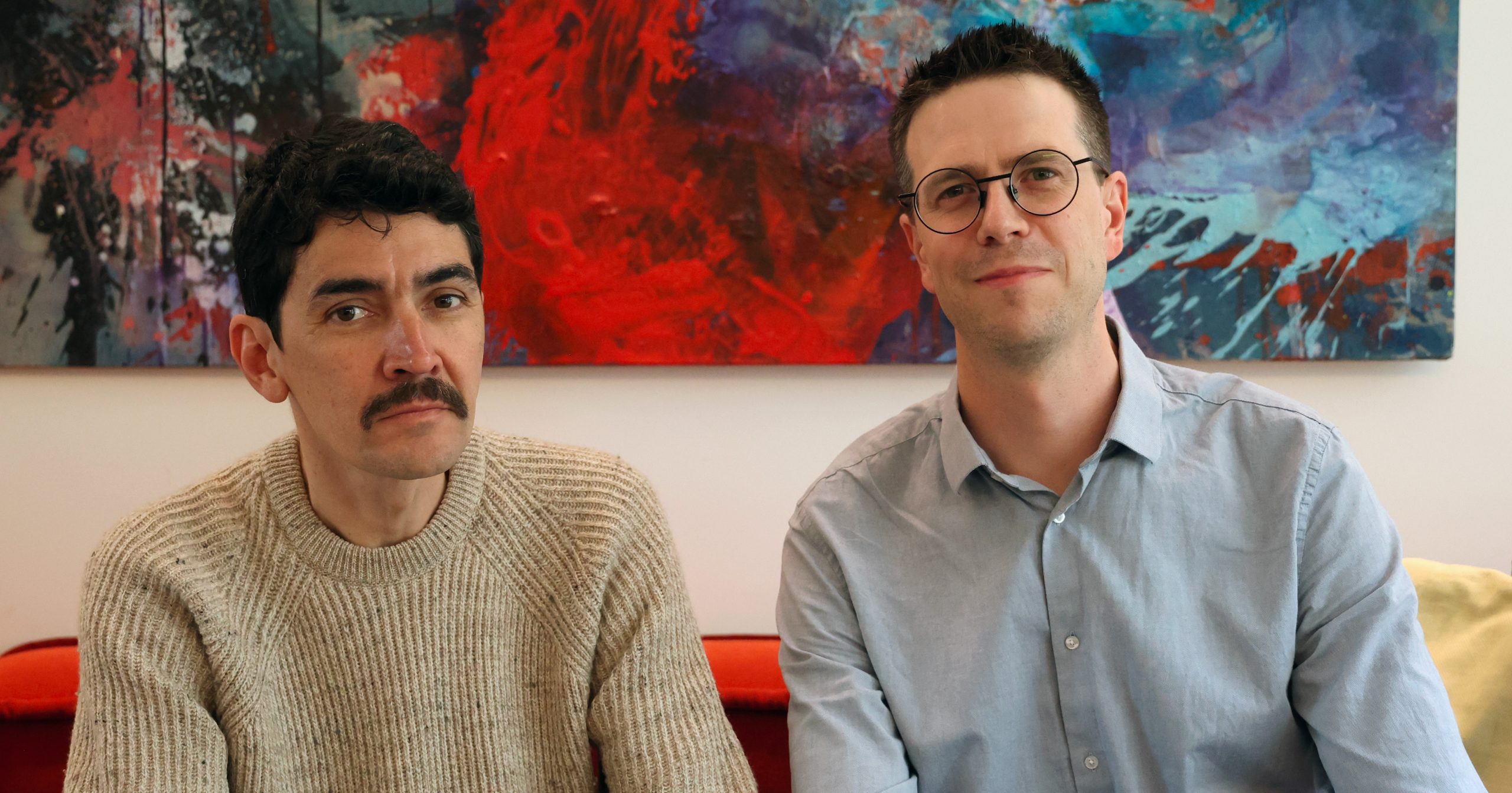
Bertrand Amiot & Julien Gaurichon
Filmmakers
September - October 2027
- Cinema
- Washington, DC
“The heart of my work was to make recording technology available to people (…) to give voice to the voiceless (…) to enable these people to express themselves and tell their own version of history.” Alan Lomax
We met in 2008, when we—Julien Gaurichon as a director and Bertrand Amiot as an editor—joined director Serge Viallet at the Institut national de l’audiovisuel (INA) to work alongside him on the documentary series Mysteries of the Archives.
Designed to reveal or rediscover images bearing witness to a century of history, the series sparked in us a true vocation as “image detectives,” as well as an obsession with traces, documents, and archives.
We were led to explore a great many audiovisual collections held in archival institutions in France and abroad. We developed a shared working method that consists, like meticulous investigators, in questioning the memories and narratives that newsreels and journalistic images have helped shape around major historical events.
We could not have imagined that this detective work would continue for almost fifteen years, nor that the series would eventually comprise 65 films and be broadcast in numerous countries.
It was during this research that we discovered the work of Alan Lomax (1915–2002), an American ethnomusicologist who devoted his life to collecting folk music and oral traditions around the world.
Drawing on our experience of archival exploration, we wish to study his collections in Washington with the aim of developing a film devoted to Alan Lomax and his work.
Julien Gaurichon studied film at Paris 8 University and directed his first film in 2000 with Frédéric Bas, devoted to the American singer Willy DeVille. Their collaboration continued with a documentary on the history of professional wrestling (Arte, 2012), followed by Two Black Dreams (France 5, 2015), a dual portrait of Martin Luther King Jr. and Malcolm X.
He subsequently directed several films about cinema and, from 2008 to 2022, co-directed around twenty films with Serge Viallet for the Mysteries of the Archives series (INA/Arte). His most recent films explore the lives of Truman Capote and the relationship between writer Ann Rule and serial killer Ted Bundy.
Bertrand Amiot is a director and television editor specializing in documentary filmmaking.
In 2008, he joined the Mysteries of the Archives series (Arte/INA), to which he contributed for almost fifteen years. This work gave him an in-depth knowledge of archival images, their sources, and their narrative potential.
In 2021, he turned to directing, driven by a desire to encounter others and to turn his attention to a range of social realities. His first film, La Valse des Platanes, co-directed with Laurie Pinon, follows the daily life of a couple running a roadside restaurant and was selected for FIPADOC 2023.
Alan Lomax was one of the greatest collectors of songs and blues in history. He inherited this vocation from his father, John Lomax, with whom he travelled through rural counties in the American South from the early 1930s onwards, in a vehicle equipped to cut sound recordings onto discs.
In Mississippi, at the heart of the cotton industry, he witnessed the tragic conditions endured by an African American working class living under the terror of Jim Crow laws: exploited by large white landowners and subjected to physical violence, police brutality, and lynching. Yet amid this oppression, he discovered exceptional musicians whose voices and instruments carried a singular artistic force, particularly through the blues.
Throughout his life, Alan Lomax returned to Mississippi, recording, photographing, and filming the people he met in order to preserve an oral, musical, and visual memory of their lives. The fieldwork carried out by Lomax and his teams from the 1930s to the 1980s formed a collection unique in the world, essential to understanding African American history and the history of the blues.
The people he encountered during his travels—musicians, preachers, and agricultural workers—became, through his cameras and microphones, witnesses and historians of their time. Their voices compose a vast oral history of the Mississippi Delta under segregation.
Drawing on our experience as “image detectives” gained through Mysteries of the Archives, we wish to study the documentation assembled by Lomax, along with the images and sounds he collected, in preparation for a film conceived both as a portrait of his work and as a choral account of rural Black America in the segregated South.
6,400 sound recordings, 5,500 still images, 6,000 moving images: the scale of Alan Lomax’s archives held at the American Folklife Center is staggering. Within this considerable body of material, a significant portion relates directly to our research: Lomax’s fieldwork in Mississippi.
The digitization and online availability of part of these archives has given us a glimpse of the richness of this memory. However, an essential part of the holdings—particularly the moving images filmed by Lomax and his teams, as well as his field notebooks—remains accessible only on site at the American Folklife Center of the Library of Congress.
Our project is to travel to Washington, D.C., in order to immerse ourselves in these archives, explore them, and understand them as material for the writing of a film. On site, we will study film footage, photographs, and field notes in order to reconstruct the context of each recording—where, when, and how it was made—cross-reference sources, and retrace Lomax’s routes during his fieldwork in Mississippi.
We will also consult the John A. Lomax and Bess Lomax Hawes collections, held at the same institution, and meet with several witnesses and specialists of his work: his daughter Anna Lomax Wood; William Ferris, a disciple of Lomax and filmmaker-ethnomusicologist; historian Tom Piazza; and Nathan Salsburg, curator of another Lomax collection held by the Association for Cultural Equity in New York.
In partnership with
Talweg production
Talweg Production is a French documentary production company founded in 2012, specializing in history, culture, society, and geopolitics films.