

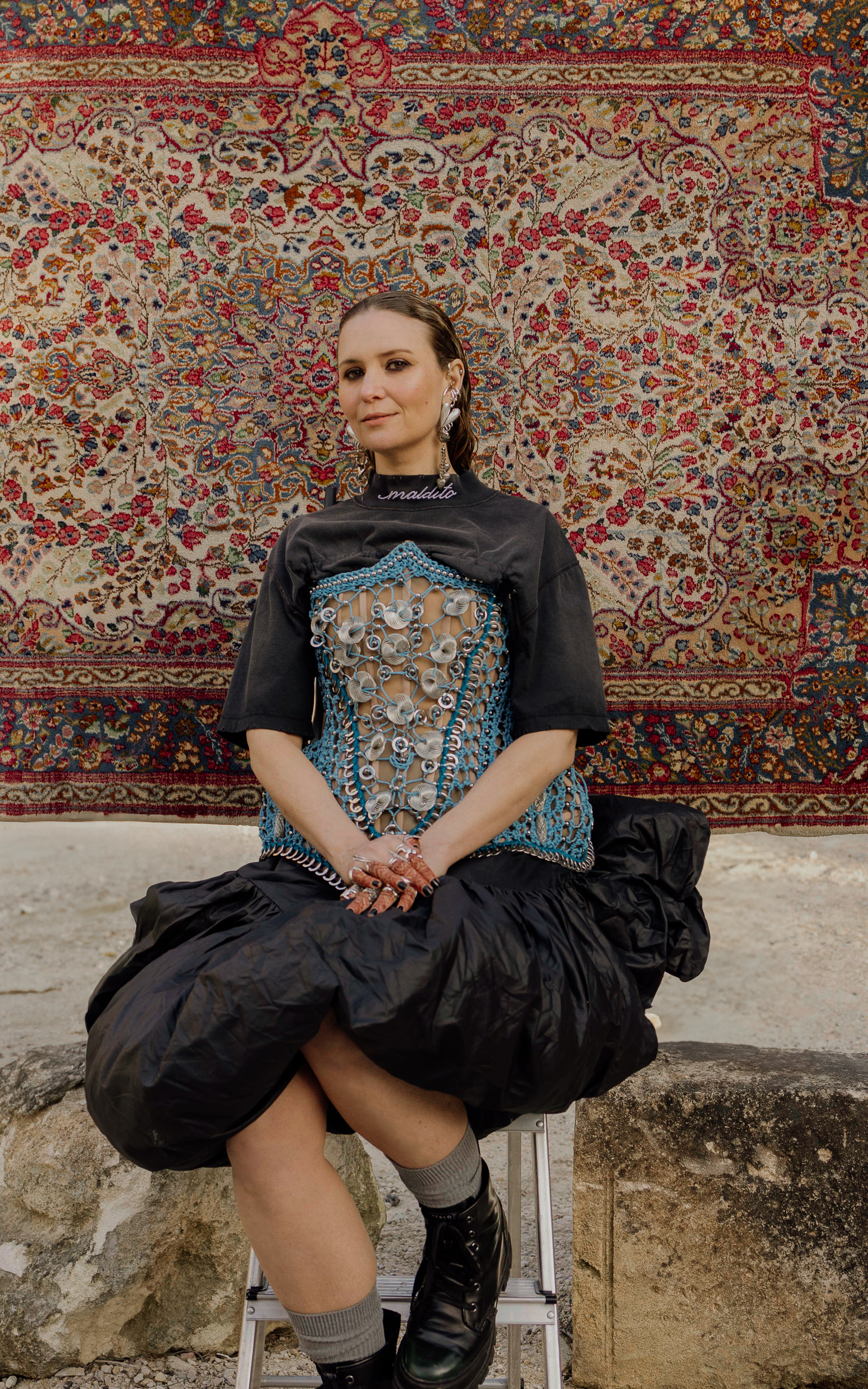
Nawel Ben Kraïem
Singer, poet
April - May 2027
- Music
- Chicago
- New York


“I want to explore the common threads between American and North African poets and songwriters, and create a dialogue between these two worlds.”
I come from a culture where poetry is primarily oral. For me, concerts and performances are a way of keeping poetry alive, bringing it into the body and the voice, and freeing it from the elitism to which it is sometimes confined. I deeply believe in the power of song and poetry. They are how I access emotion, spirituality, and critical thought.
I grew up in Tunis until the age of sixteen, before moving to Toulouse and then Paris. My family is from rural southern Tunisia, while my mother comes from a rural family in southern France. I was shaped by these contrasting landscapes. Socially, culturally, and emotionally, they awakened in me a sensitivity to the margins, to cultural hybridity, and to what these perspectives can bring to art.
Through my work, I explore the intersections between migration and belonging, women’s voices, spirituality, resistance, and cultural hybridity. My creative process is both a journey of creation and one of transmission and memory. Alongside my own songs and poems, I regularly give voice to artists of North African heritage who express themselves at the intersection of poetry, activism, and tradition.
In North Africa, the relationship between poetry and music is millennia-old. The tradition of Malhun, sung popular poetry, runs through my family memory. At the same time, my work has been nourished by dialogues between North African and African American cultures. I discovered Audre Lorde, and then bell hooks, whose poetry and activism helped me understand my position as a woman artist between several worlds.
Patti Smith showed me the connection between music and literature, and she herself was inspired by Isabelle Eberhardt and her love of North Africa. I followed that path in my own way, traveling to Algeria to pay tribute at the grave of Rachid Taha, an artist and muse whose influence extends across France, the United States, and beyond.
For 2027, I would like to develop a new album as a tribute to Rachid Taha, drawing particularly on Barbès and Diwan 1 & 2, while bringing these influences into dialogue with my own world and inspirations.
Growing up between France and Tunisia, Nawel Ben Kraiem began her music career in Paris as the singer of Cirrus Group. In 2009, she released her album Mama Please (Iris Music / Harmonia Mundi) and won the RFI Discovery Prize in Monte Carlo. After touring internationally, she launched a solo career with a distinctive crossover style blending Tunisian Arabic, French, and English. She has collaborated with artists including Axel Bauer and Agnès Jaoui, and has opened for Natacha Atlas, Susheela Raman, and Ayo.
I had the opportunity to meet Rachid Taha and, over the past four years, to perform regularly with his band, L’Armée Mexicaine, on tribute tours, notably in Algeria.
This experience was a turning point. It inspired me to create a new album as an echo of and dialogue with his work—a kind of “Diwan echo.” Just as he brought together songs that resonated with his memory and heritage, I want to bring together songs and poems that have marked me, drawing from Tunisian heritage and African American poetry through a punk-rock lens.
His first album, Barbès, recorded in the United States in 1991, at the height of the grunge era, gave his music a strong international dimension.
His album Diwan, released in 1998, paid tribute to the great voices of Raï and traditional Arabic music. He also wove Arabic poetry and political themes into his work, from the Algerian War to the rights of immigrants.This residency would be an ideal opportunity to explore and integrate African American poetry into this project, and to create a dialogue between North African and American cultures, as Taha did throughout his musical journey and through his engagement with rock.
I propose to spend time in New York immersing myself in the music scene, meeting local artists, university professors, and cultural partners, and retracing the recording process of Barbès with members of the original team who worked on the album and who are still active in New York.
I would also like to travel to Chicago to deepen my understanding of contemporary American and African American poetry and explore how it might resonate within this project.
Carrying out this project in the United States would allow me to pay tribute to my artistic muses while building a direct dialogue between North African and American cultures.
Choosing New York and Chicago means immersing myself in the physical places where African American poetry became a tool for political liberation. Chicago offers a living memory of working-class histories and migration, mirroring North African experiences of displacement and exile. New York offers the polyphony of a global city where diasporic poetry is reinvented every day.
For me, as a poet and singer, these two cities embody a geography of breath and voice: blues and slam poetry in Chicago, and the spoken-word tradition in New York.
My project is not simply about meeting people involved in these traditions, but about inhabiting these spaces: neighborhoods, open-mic venues, archives, and sites of memory. The urban tensions and cultural richness of these two cities will provide the material for the writing and musical compositions I will create following this period of research and immersion.
New York embodies a cosmopolitan crossroads of diasporas and a nerve center of literary polyphony. It is a historic birthplace of poetry as a powerful instrument of political emancipation, shaped by leading figures of the Harlem Renaissance and the Black Arts Movement, such as Langston Hughes, Audre Lorde, and Amiri Baraka. The city offers a unique meeting point for languages, memories of immigration, and the power of spoken word—an ideal setting for exploring connections between North African and African American poetic traditions. With its diasporic communities, independent journals, and archival institutions such as the Schomburg Center for Research in Black Culture, New York also provides an essential transatlantic bridge for documenting and sustaining the circulation of ideas and struggles between Africa, the Caribbean, and the United States.
Chicago likewise stands out as a living laboratory of African American creativity and a historic crossroads of resistance. A major center of the Great Migration, the city saw the emergence of an urban, working-class, politically engaged poetry whose narratives of uprooting and rebuilding resonate with the history of North African diasporas. Rooted in an activist tradition exemplified by figures such as Gwendolyn Brooks and the publishing house Broadside Press, this poetry forges an inseparable connection between poetic writing, public space, and community engagement. For a singer and poet, Chicago also offers a distinctive sonic geography: a birthplace of blues, urban jazz, and slam poetry. Finally, this legacy of local struggles—from Fred Hampton’s Black Panther Party activism to contemporary movements such as Black Lives Matter—resonates directly with North African activist poetry, anticolonial engagement, and literatures of liberation. Their political commitments find expression through the lens of the intimate, which lies at the heart of both my interests and my artistic practice.
In partnership with
Institut du monde arabe
The Institut du monde arabe was founded in 1980 by France and the League of Arab States to promote and highlight Arab culture in all its forms. Housed in a building designed by the eminent architect Jean Nouvel and Architecturestudio, this genuine hub of encounters and exchanges opened its doors in 1987. For the past 35 years, the Institut du monde arabe has continued to strengthen cultural, political, economic, and social connections between France and the Arab world.