

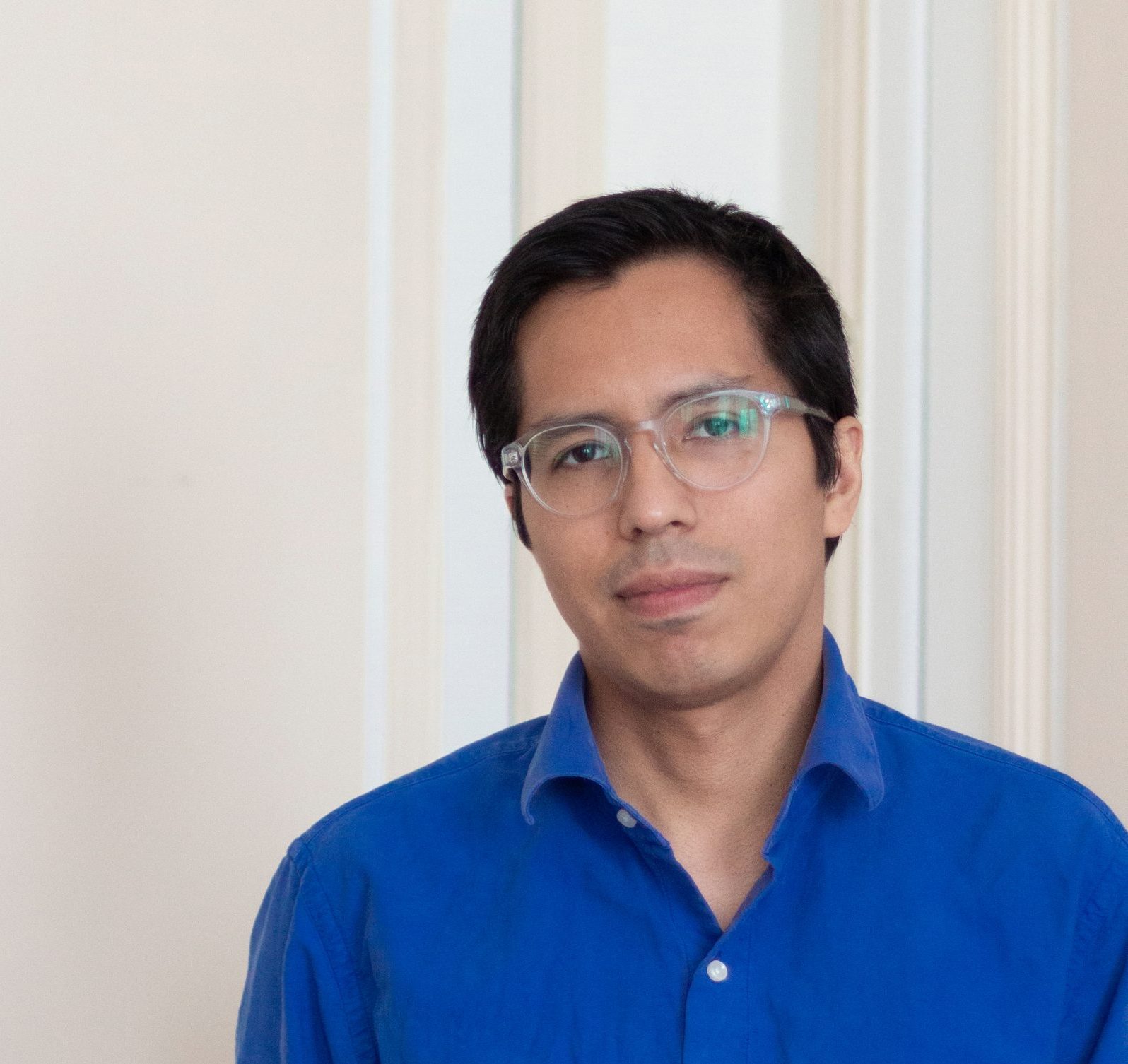
César Augusto Ramírez
Artist
April-May 2027
- AI
- New York


“In its early days, the democratization of photography served to document the world. Today, with new technologies such as AI, photography is less concerned with recording the world than with generating new ones.”
I am a Peruvian artist who has been based in France since 2022. My background is in professional photography and digital tools. My practice operates at the intersection of the physical and the digital, seeking to explore the political tensions between images and the technologies that shape them. From the outset, my work has questioned the image itself: its role as a narrative tool, its potential and limitations as a visual medium, but also its ability to represent and recompose reality.
Initially working with photographs drawn from military archives, I sought to shed light on the Peruvian military mindset, intertwining it with more intimate concerns such as queer identity and the figure of marginalized youth. My practice subsequently shifted toward a more tautological exploration of the image, questioning its indexical nature and even its material dimension. For the past three years, my work has continued to focus on the nature of the image and, above all, on the ability of artificial intelligence to construct new realities, with the aim of reflecting on the possibilities technology may offer us to imagine other forms of non-human life and find ways of attuning ourselves to them.
Born in the Peruvian jungle, where I spent my early childhood before migrating to France, I retain fields and plants as some of my earliest memories. This experience has deeply shaped my current practice, which focuses on botany and the condition of the Other within society.
César Augusto Ramírez is a Peruvian artist based in France. A graduate of Université Paris 1 Panthéon-Sorbonne, he has developed a practice centered on the use of computer-generated imagery to explore the political and ecological tensions of technology, as well as alternative ways of inhabiting the world. His work has been exhibited in France, Peru, the United States, Mexico, and elsewhere, notably at Galerie du Crous de Paris and Now Gallery, as part of the ICPNA Contemporary Art Prize and the Cusco Art Biennial, as well as at MATE Museum and Centro de la Imagen, among others.
The Plant that Ate the North is a new project conceived specifically for Villa Albertine in New York. It builds on my current research into invasive plants, weaving it together with reflections on new ecological narratives, artificial images, and systems of social power. The project explores how generative AI can be used to create artificial plant species, questioning how technology and images can challenge the boundaries between reality and fiction, and generate new narratives around ecology and our coexistence with nature.
The goal of my residency is to create image databases of the plants found in Central Park, which I see as a perfect example of coexistence between nature and the human city. Once these image databases have been assembled, I will use them to train AI models capable of designing new artificial plant species based on those found in the park.
These new species will then be printed on paper using the cyanotype technique, a photographic printing process invented in 1842 and used by Anna Atkins to publish the first herbarium of British native plants. In this sense, the historical significance of the cyanotype process in the creation of botanical atlases of local plants is diverted in my project to create a new atlas of artificial plants, presented as though they were invasive species on American soil. Similarly, the conception of photography as a “trace of reality” is reversed through the use of AI to create hyperrealistic models of artificial botanical species.
For me, Central Park embodies a perfect example of the integration of nature within the human city. New York is also home to several important institutions for this project, including the New York Botanical Garden, the Brooklyn Botanic Garden, the American Museum of Natural History, and the New York Public Library.
The New York Botanical Garden houses the William and Lynda Steere Herbarium, which contains more than 7.8 million specimens and is one of the largest herbaria in the world. It also houses the LuEsther T. Mertz Library, one of the world’s most important botanical libraries, with historical botanical atlases and publications that are open to the public.
Although the Brooklyn Botanic Garden has a more modest collection, it houses an excellent research library with historical collections of botanical books and atlases, available for consultation by appointment. The garden also maintains databases documenting its living collections.
The library of the American Museum of Natural History holds significant collections of historical botanical literature, including atlases and botanical illustration books, which are accessible to the public for research purposes. Similarly, the NYPL–Stavros Niarchos Foundation Library holds an extensive collection of botanical literature, historical atlases, and digital resources.
In partnership with

École des Arts de la Sorbonne
The École des Arts de la Sorbonne (EAS) is the School of Arts and Art Sciences at Université Paris 1 Panthéon-Sorbonne. Offering programs from undergraduate to doctoral level, it combines artistic practice with theoretical inquiry across fields including visual arts, film, design, aesthetics, and cultural professions.

Fidji Simo
CEO, Applications at OpenAI
Fidji Simo is CEO, Applications at OpenAI, where she leads the company’s applications such as ChatGPT, and all of its operations – including product development, engineering, sales, finance, marketing, legal, and people teams. A seasoned consumer technology leader, she has spent more than 15 years driving product, strategy, and operations for some of the world’s most influential companies.
Before joining OpenAI, Simo was Chief Executive Officer and Chair of Instacart, guiding it through its successful public offering. Prior to Instacart, she spent a decade at Meta, where she built Facebook’s advertising business and led the Facebook app.
Simo remains Chair of Instacart’s board and also serves on the Board of Directors at Shopify. She is the co-founder of Chronicle Bio, a tech‑bio company on a mission to cure complex chronic conditions.
Originally from the south of France, Simo holds a Master of Management from HEC Paris and completed her final year at UCLA Anderson School of Business. She now lives in California with her husband and daughter.