

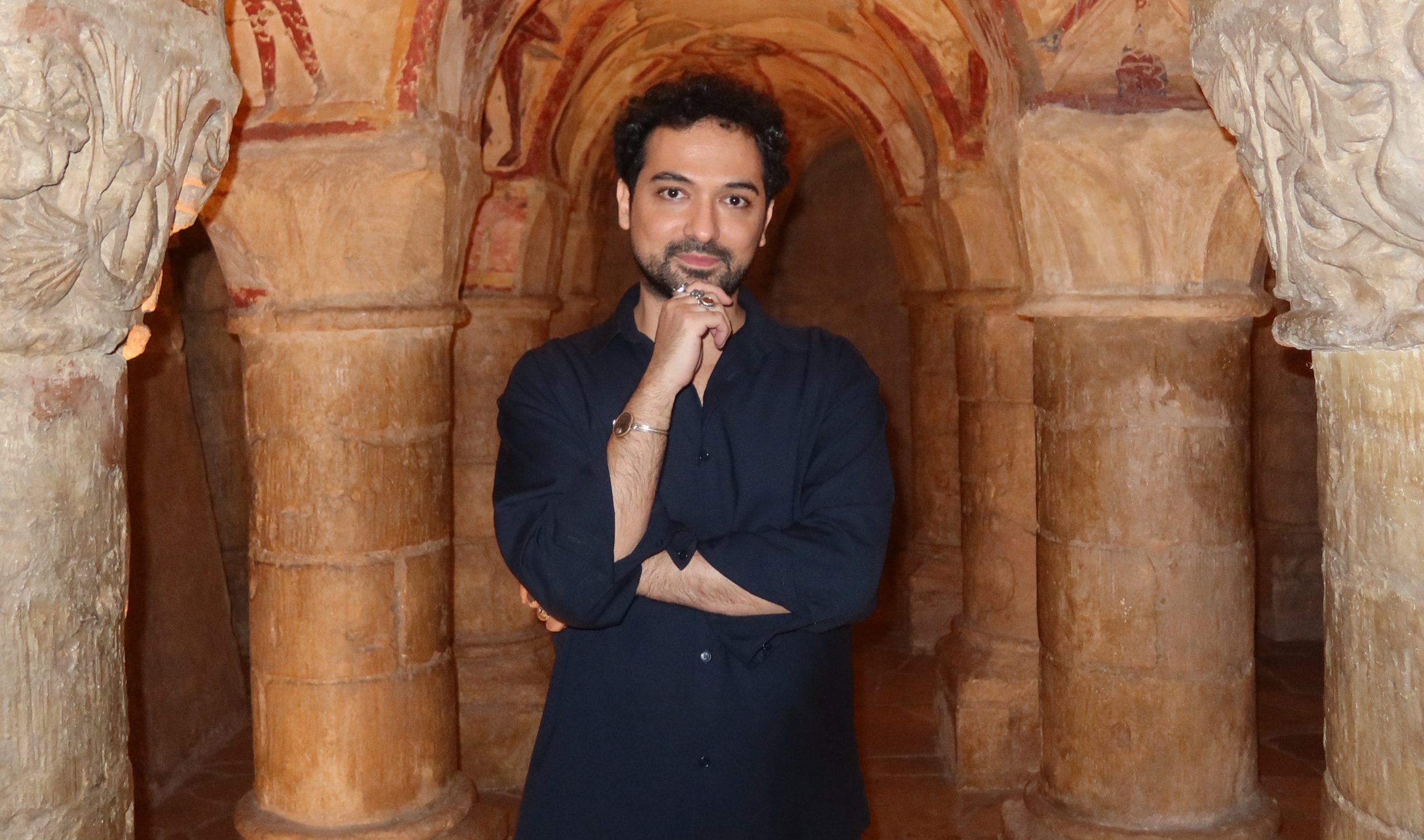
Mete Kutlu
Researcher in cosmotechnics, artist and architect
March - April 2027
- AI
- Atlanta

“Beneath every cloud lies a mountain. Beneath every algorithm, a crystal. From Cherokee cosmology to microchips, artificial intelligence reveals a planet that has always been thinking.”
I am an artist, architect, and researcher exploring the relationships between cosmology, technology, and visual culture. My practice combines historical research, artistic creation, and technological experimentation. Through augmented reality, photogrammetry, machine learning, and digital simulation, I investigate how civilizations imagine the universe and externalize intelligence as images, architecture, and technology. My work traces the spiral of history, from the crystal to the cloud, as cultures oscillate between anthropocentric and cosmocentric visions of the world.
For the past six years, I have been following the trail of a single cloud figure across the Silk Road. This journey has taken me from the secret archives of the Vatican to the architectures of machine learning, from Tokyo to Constantinople. In the personal library of the Ottoman sultan, I began to recognize the prototypes of our own algorithmic future. The cloud emerged as the new shape of thought, revealing a shift from a society of geometry to a society of meteorology. The pigment becomes the algorithm. The pixel becomes the cosmos.
At the heart of my work lies a simple question: how do technological revolutions reactivate ancient ways of imagining the universe? I investigate how myths become technologies, and technologies become new myths. I propose an alternative genealogy of the algorithm, where the oldest cosmologies return through the newest technologies. I call this condition the primitive future.
Mete Kutlu holds a PhD in Architecture from Université Gustave Eiffel, conducted under joint supervision with Tongji University in Shanghai. He has conducted research at institutions including the Vatican Apostolic Library and Topkapı Palace in Istanbul. He has held research residencies at Villa Medici in Rome, the Giorgio Cini Foundation in Venice, the French Palace in Istanbul, and the French Institute of Central Asian Studies in Samarkand. He received the Daniel Arasse Prize from the French Academy and the French School of Rome. His project Spolia botanique was a laureate of the French Ministry of Culture’s Innovative Digital Services program.
Thinking Rocks: From Cherokee Myths to AI Chips is an immersive video essay on the crystalline foundations of artificial intelligence embodied in cloud infrastructures. The project visualizes AI as a planetary system attempting to understand its own material body through petrography, just as humans seek to understand theirs through biology. By placing Cherokee myths in dialogue with contemporary chip fabrication, the project proposes a geological vision of artificial intelligence, not as a force opposed to nature but as one emerging from Earth’s lithic intelligence. Through microscopic imaging of minerals and their transformation by neural networks, the video essay evokes variegated speculative cosmologies within this mineral nervous system.
The project is rooted in the geology of Spruce Pine, North Carolina, whose exceptionally pure quartz makes possible the production of the silicon crystals used in contemporary microchips. Long before the digital age, crystals already occupied a central place in Cherokee cosmology as media of knowledge. According to Cherokee tradition, the mythical being Nunyunuwi leaves behind a quartz crystal containing the knowledge necessary for the beginning of human civilization. Thinking Rocks reveals unexpected continuities between Indigenous cosmologies and contemporary computation.
During the residency, I will conduct fieldwork across the Appalachian Mountains using polarized-light microscopy to produce microscopic images of minerals central to AI infrastructure. These images will form a dataset for an artificial neural network speculating on its own technological body. From clay tablets to silicon chips, mineral surfaces have long functioned as substrates of memory. The silicon microchip can be understood as the pottery of today, a product of ceramic technology. Intelligence thus appears as a global process distributed across organic and mineral systems in the neo-ceramic age. Thinking Rocks constructs a contemporary myth of AI, in which the planet itself becomes the site of intelligence.
My project is inseparable from the Blue Ridge Mountains of western North Carolina, where the geological foundations of contemporary artificial intelligence intersect with Appalachian landscapes, Cherokee cosmologies, and the semiconductor industry. Conducting this research in the United States is essential because the project depends on direct engagement with the places where the material body of AI begins. The residency continues my investigation into the entanglement of cosmology, geology, and computation, extending it from the Silk Road to the Appalachian Mountains.
During the residency at Spruce Pine, I will engage with the principal actors in the extraction and processing of high-purity quartz, including Sibelco and The Quartz Corp. Yet the virtual cloud depends not only on the geology of the Appalachians, but also on their meteorology. When Hurricane Helene temporarily halted quartz extraction in 2024, it revealed how even the virtual cloud depends on the atmosphere. This convergence of geology, climate, and computation makes western North Carolina a unique place from which to rethink artificial intelligence as a territorial system.
I will spend time in Cherokee, learning about Indigenous myths and crafts that continue to shape relationships with the mineral landscape. Throughout the residency, I will collect mineral samples, produce microscopic images, and record the acoustic ecology of the Appalachian landscape. These materials will become the visual and sonic foundation of Thinking Rocks.
In partnership with

Comet Lab
Comet Lab is a research and development platform dedicated to digital experimentation, exploring the intersections of art, technology, and territories through digital mediation, immersive experiences, and mapping.

Fidji Simo
CEO, Applications at OpenAI
Fidji Simo is CEO, Applications at OpenAI, where she leads the company’s applications such as ChatGPT, and all of its operations – including product development, engineering, sales, finance, marketing, legal, and people teams. A seasoned consumer technology leader, she has spent more than 15 years driving product, strategy, and operations for some of the world’s most influential companies.
Before joining OpenAI, Simo was Chief Executive Officer and Chair of Instacart, guiding it through its successful public offering. Prior to Instacart, she spent a decade at Meta, where she built Facebook’s advertising business and led the Facebook app.
Simo remains Chair of Instacart’s board and also serves on the Board of Directors at Shopify. She is the co-founder of Chronicle Bio, a tech‑bio company on a mission to cure complex chronic conditions.
Originally from the south of France, Simo holds a Master of Management from HEC Paris and completed her final year at UCLA Anderson School of Business. She now lives in California with her husband and daughter.