

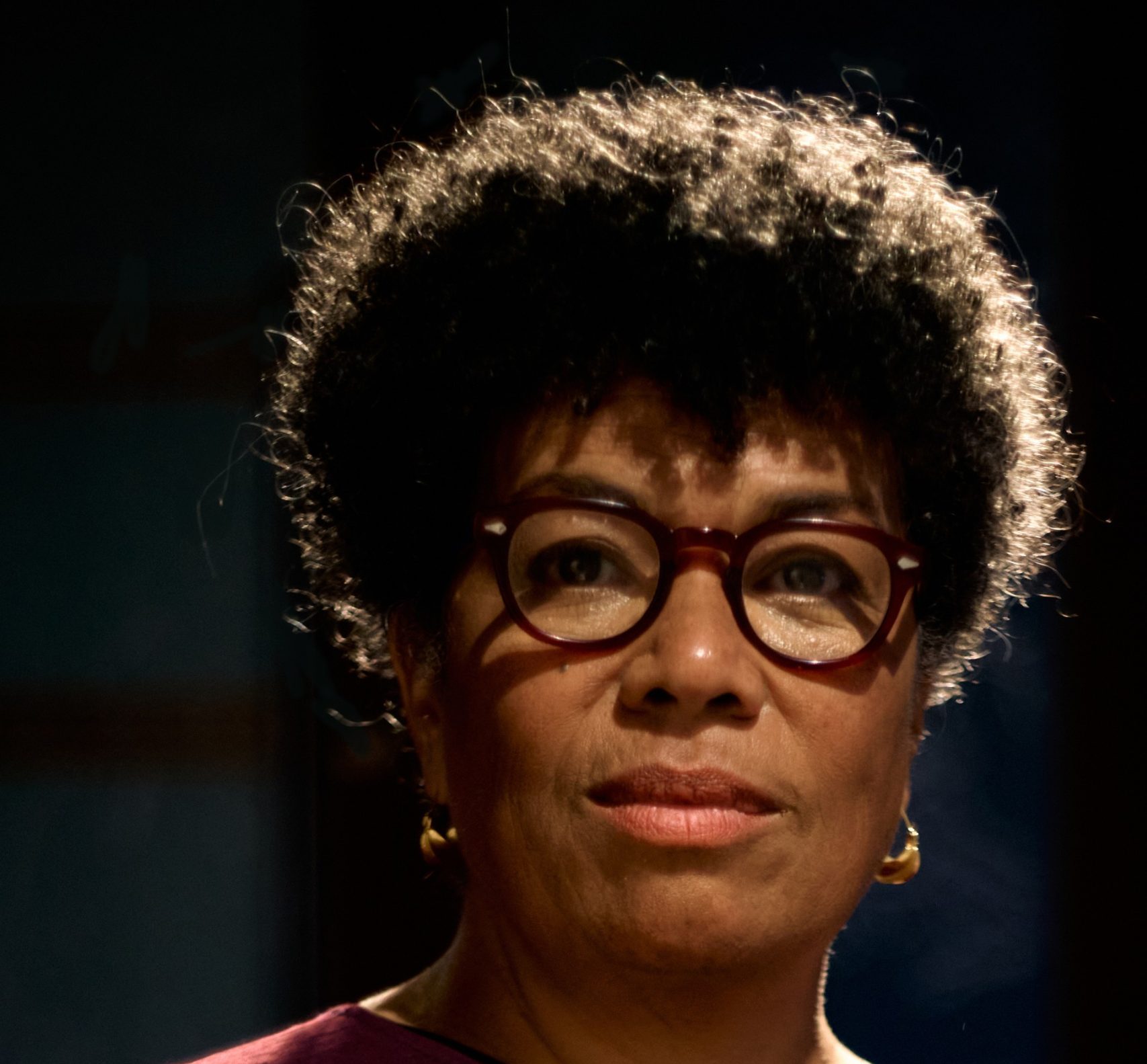
Sylvaine Dampierre
Filmmaker and visual artist
Spring 2027
- New Media
- New Orleans


“When I realized that these men whose traces I am seeking spoke Creole, the language my father never taught me but that has spoken to me all my life, I knew that I could inhabit their memory.”
As a mixed-race woman of French and Guadeloupean heritage, I experience identity as a quest, a journey. After studying literature and the arts, I became a film editor before joining Ateliers Varan, the documentary film school founded by Jean Rouch, where I still teach today. In 2010, I founded Varan Caraïbe in Guadeloupe to support the emergence of Caribbean documentary cinema.
My desire for expression is rooted in documentary filmmaking: in giving a voice to those who are not listened to, in inscribing their presence and their stories. Memory, rootedness, and traces lie at the heart of my work as a filmmaker and visual artist. I explore the gaps in the memory of slavery, seeking to inhabit these absences and make their silences resonate.
In recent years, my practice has shifted towards a dialogue between cinema, photography, sound-based storytelling, and visual art, through the creation of immersive installations that offer an experience of moving through memory. The archive, and its materiality—its irruption into the present and its re-inscription within it—is a constant motif in my work.
This is how I came across the photographs of Black soldiers of the American Civil War. Free Black men and formerly enslaved men who had escaped plantations in the South, nearly 200,000 of them enlisted in a conflict in which abolition became a major issue. By enlarging their images to life-size on semi-transparent sails, I re-inscribe their presence and question the visibility of a history whose erasure still resonates today.
Sylvaine Dampierre has directed documentary films that have been selected for and received awards at numerous international festivals, including two feature-length films shot in Guadeloupe: Le pays à l’envers (2009), which received the Heritage Award at Cinéma du Réel and the Trophée des Arts Caribéens; and Paroles de Nègres (2020), which received the International Critics’ Award at DOK Leipzig and the Best Documentary Feature Award at the Trinidad and Tobago Film Festival, and was selected for IDFA, Miami’s Third Horizon Film Festival, and IFFF Köln. Between 2022 and 2024, she developed the immersive installation The Words of Negroes as part of the European MANIFEST residency.
Black Soldiers, the Suspended Image is based on photographic archives of Black soldiers from the American Civil War. Most are albumen prints in the format of carte-de-visite photographs, whose reproducibility and circulation were made possible by technological advances in the 1860s. For many Black recruits, this was their very first opportunity to be photographed, by white photographers who followed the Union garrisons. These representations are deeply ambivalent: they oscillate between propaganda and self-assertion, between imposed identities and emancipation.
I appropriate these portraits of soldiers and Contrabands—fugitive enslaved people photographed upon their arrival behind Union lines—and re-inscribe them in the present, as bodies to encounter. I enlarge them to human scale, in order to re-enact their embodiment and reach a form of monumentality. I paint them in black and white on textile supports. On these hanging screens, the figures exist as much through projection as through imprint, at the intersection of photography, cinema, the painterly gesture, and material experimentation—as they are embroidered or worked in three dimensions.
These drawings form the matrix of an immersive installation that the residency in Louisiana will give greater depth to: encounters with historians, researchers, and descendants of this buried history; immersion in the cultural vitality of the region and the contemporary echoes of this history; and exploration of its landscapes and memorial sites. This immersion will give body and voice to my research. In particular, I am undertaking a visual and literary investigation into Peter, known as Scourged Back, the man with the lacerated back, an enslaved man who escaped and was photographed in Baton Rouge in 1863. To deepen and ground this story, to bring this fragile yet enduring figure back to the place where his story began, and literally suspend him within his original landscape, could initiate a fertile artistic and memorial gesture.
I do not know New Orleans; I come—at least half—from another America, the one that curves around the Caribbean Sea, that archipelago haunted by memory. The story of the Black Soldiers inevitably leads me to Louisiana, and Louisiana brings me back to Guadeloupe, my father’s homeland. In Louisiana, slavery first spoke French, and when I realized that these men whose traces I am seeking spoke Creole, the language my father never taught me but that has spoken to me all my life, I knew that I could inhabit their memory. New Orleans then emerged as the place for this quest: there, I will trace time backwards, back to the origins of these images.
I can delve into the archives from afar; I have done so before. But what Louisiana alone offers me is a territory where memory is still a struggle: a city that has removed its Confederate monuments, leaving behind empty pedestals and streets to be renamed, without settling the debate over what America chooses to erase or preserve. It is in this fissure that I want to inscribe these faces, these bodies, these stories.
I want to meet the heirs of this history, its keepers and those who carry it forward, those who preserve its language, those to whom it still speaks; to travel along the plantations of River Road and their quarters, see the bayous where fugitives sought refuge, the fields of sugarcane and cotton; and to uncover traces there, to suspend a presence.
In partnership with

Mémorial ACTe
Mémorial ACTe is a Caribbean center dedicated to the memory of the transatlantic slave trade and slavery, bringing together history, research, contemporary art, and education in Guadeloupe.