
Villa Albertine Commissions Abdelkader Benchamma to Reimagine the Ceiling of Its Ballroom
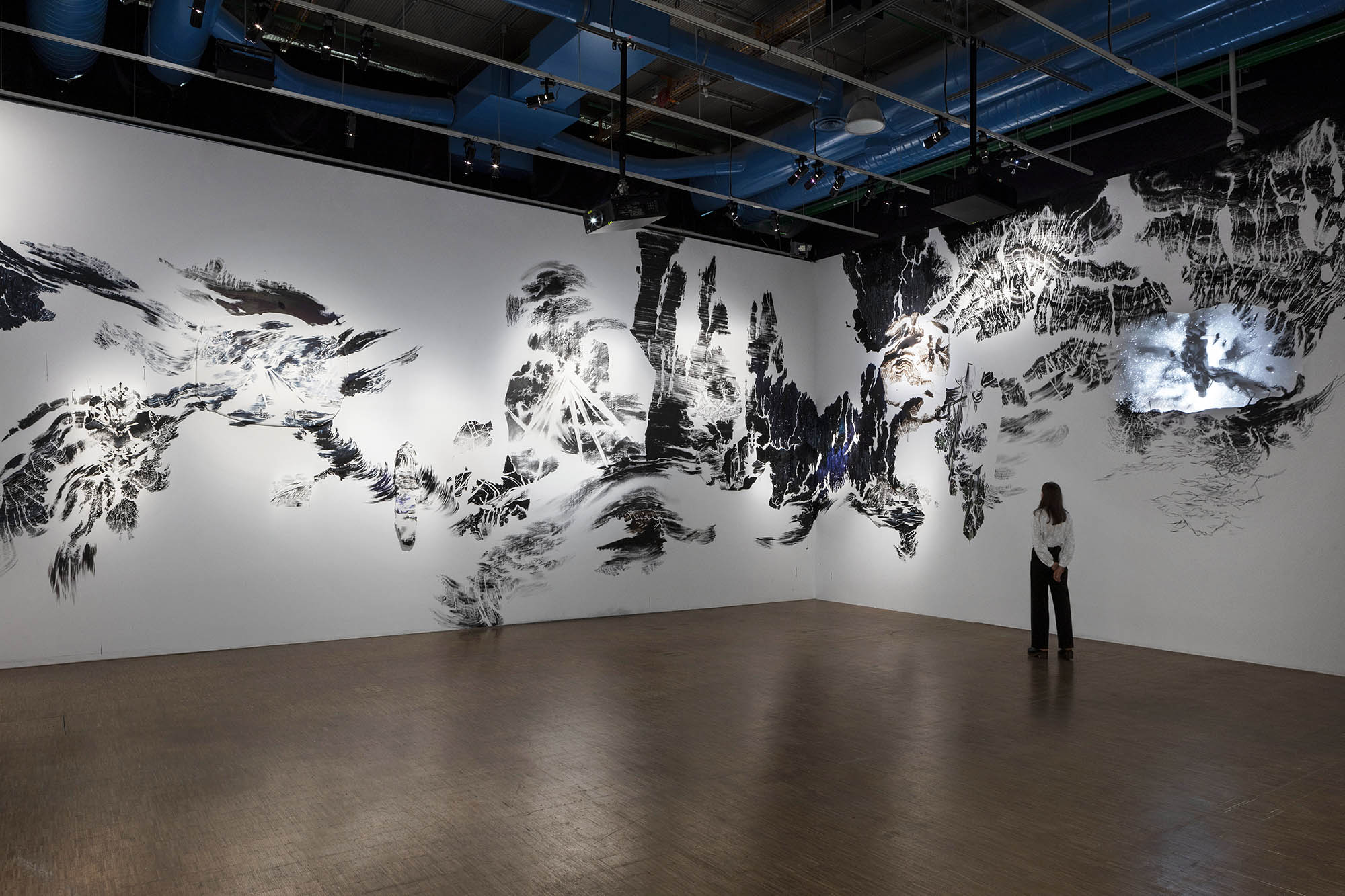
Au bord des mondes, Marcel Duchamp Prize, Centre Pompidou, Paris, 2024. Photo: Tanguy Beurdeley
By Villa Albertine
Abdelkader Benchamma’s monumental project has been selected to transform the ceiling of Villa Albertine’s Ballroom, at the heart of one of New York’s most significant cultural landmarks.
New York, June 23, 2026—Villa Albertine, the French Institute for Culture and Education within the French Embassy in the United States, is delighted to announce the selection of Abdelkader Benchamma to create a monumental work for the ceiling of its Ballroom, one of the most emblematic spaces within the Payne Whitney Mansion, home to Villa Albertine in New York, which hosts numerous cultural, intellectual and diplomatic events.
This project reflects Villa Albertine’s commitment to preserving and reactivating historic spaces through contemporary creation and the free movement of ideas. By commissioning a leading living artist to transform the Ballroom ceiling, Villa Albertine continues its broader effort to reimagine the Payne Whitney Mansion while honoring its architectural legacy.
“Stella Terrae is a vast mural in perpetual motion. It is dynamic in its very making, created in situ, in dialogue with the scale and tensions of the space, yet seemingly still through the delicacy of its execution: an invitation towards contemplation.
Its title refers to a mysterious substance sometimes reported after meteorite falls. Known as “star jelly,” astromyxin, or stella terrae (“star of the earth”), it is surrounded by myths and contradictory interpretations, as though the celestial realm could never be fully defined, explained, or contained.
From this idea emerges the installation: to reintroduce a poetic force into the sky at a time when outer space is increasingly becoming a territory to control, exploit, and colonize.
The project will re-enchant the Ballroom ceiling by drawing upon imaginaries rooted in the history of celestial and cosmological representations, from painted ceilings to star charts. It engages in particular with the Nebra Sky Disk (c. 1600 BCE), one of the oldest known depictions of the heavens, and the Dunhuang Star Atlas (7th century), which records more than 1,300 stars.
At its core, the mural tells an essential story: humanity’s relationship with the sky, shaped by observation, knowledge, and imaginative narratives. It situates itself within a long continuum of ways of representing the cosmos while offering a contemporary interpretation of that legacy.
Ultimately, it is an act of survival and continuity: that of a humanity that continues to observe, interpret, and project itself toward the heavens.” – Abdelkader Benchamma
Selected figurative elements will be created in conjunction with American artist Raymond Pettibon, continuing the series of collaborative drawings the two artists have developed together since 2019. This unprecedented partnership anchors the project within a unique Franco-American artistic dialogue.
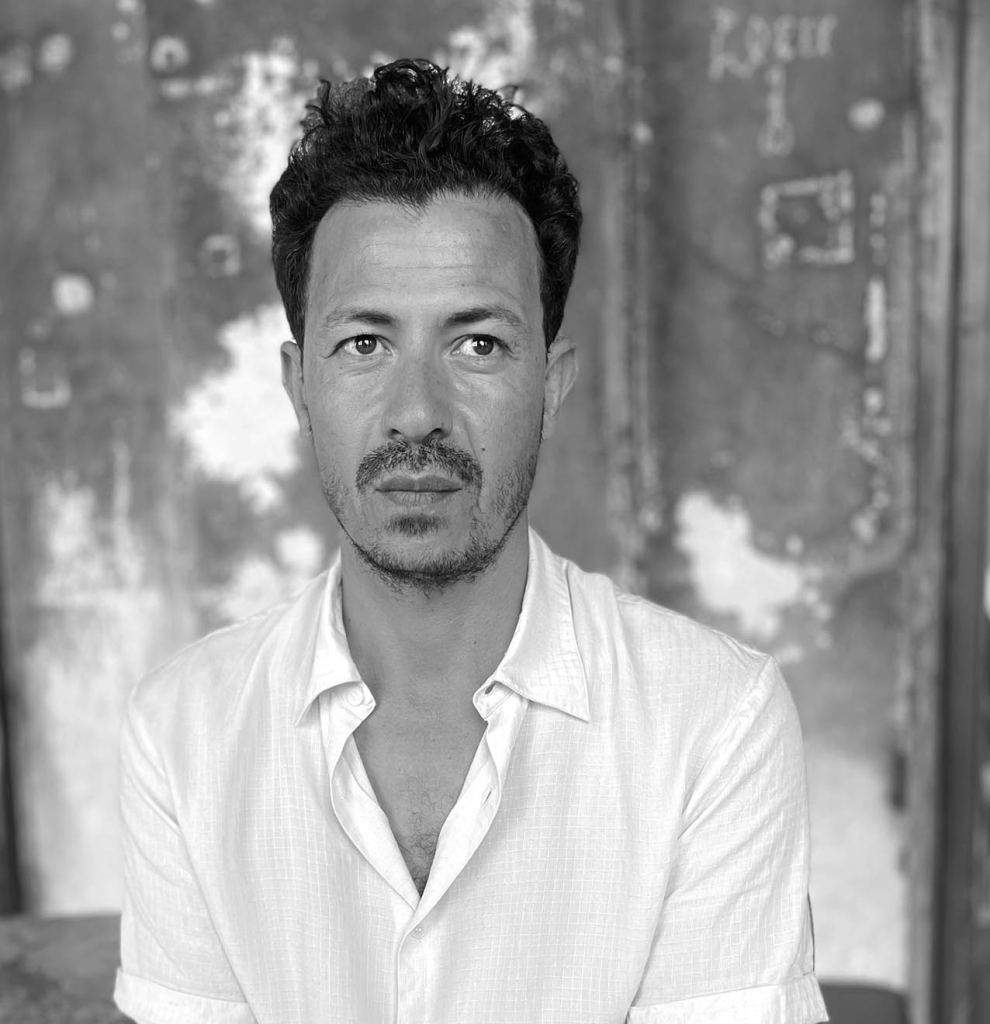
Abdelkader Benchamma. Photo: Virginie Jacquet
Working between Paris and Montpellier, Abdelkader Benchamma graduated from the École supérieure des Beaux-Arts de Montpellier and the École nationale supérieure des Beaux-Arts, Paris in 2003. Winner of the Drawing Now Prize in 2015, Benchamma was invited that same year by The Drawing Center of New York to launch their mural drawing program with Representation of Dark Matter (2015-2016). Benchamma has since had numerous solo exhibitions and group shows throughout France and Europe as well as in the Middle East, the Americas, and Asia. In 2024, Benchamma was a finalist for the Marcel Duchamp Prize for which he presented the installation Au bord des mondes at the Centre Pompidou. In 2026, the museum Espai d’Art Contemporani de Castelló (EACC) in Castelló de la Plana in Spain dedicated Benchamma an important personal exhibition from June until September. From October until December, he will join the residency program of Villa Albertine in New York, thereby further enriching his conversation with the American artistic scene.
A major figure in contemporary American drawing, Raymond Pettibon is renowned for his ink drawings, which weave together punk culture, literature, history, popular imagery, and American counterculture in a visual language that is at once erudite, ironic, and deeply independent. Frequently embodying the great myths of America, his works subtly engage with and challenge our contemporary imagination.
This commission has been made possible through the exceptional support of the Sisley-d’Ornano Foundation, with additional support from French Heritage Society’s New York Chapter and Ann and Bill Van Ness.
The project was developed in close collaboration with the Centre national des arts plastiques (CNAP), a leading institution for contemporary public commissions and international artistic competitions. The competition received 225 submissions, demonstrating the vitality and diversity of contemporary French creation.
The Ballroom ceiling commission represents a new chapter in the ongoing transformation of Villa Albertine’s historic headquarters. The Ballroom, a majestic reception space overlooking Fifth Avenue, is the beating heart of the institution, hosting major artistic, intellectual, and diplomatic events each year. Following landmark projects including the Atelier by designer Hugo Toro and Albertine bookstore by designer Jacques Garcia, this initiative furthers Villa Albertine’s commitment to bringing contemporary creation into dialogue with architectural heritage.
“With this ambitious commission, we are pursuing a long-term vision for the Payne Whitney Mansion: to preserve the site’s exceptional heritage while opening it up to the most compelling forms of contemporary creation. The work conceived by Abdelkader Benchamma will permanently establish Villa Albertine within New York’s artistic landscape as a place where heritage engages in dialogue with the vitality of today’s French art scene. I would like to acknowledge the decisive role of CNAP, a valued partner at every stage of this process, as well as the generous support of our principal patron, the Sisley-d’Ornano Foundation. Through the power of his imagination and the scale of his artistic vision, Abdelkader Benchamma will leave a lasting mark on one of New York’s most remarkable historic buildings,” said Mohamed Bouabdallah, Cultural Counselor of France in the United States and Director of Villa Albertine.
“Through this commission, CNAP continues its mission to support the creative work and international visibility of French artists. This exemplary partnership with Villa Albertine illustrates CNAP’s role as a leading partner in public commissioning, contributing its expertise to the management of ambitious projects and exceptional venues such as the Payne Whitney Mansion,” explained Martin Bethenod, Director of the Centre national des arts plastiques.
Villa Albertine will unveil this significant commission in September 2026. The project further advances Villa Albertine’s mission to foster dialogue and exchange between the United States, France, and the French-speaking world through contemporary creation.
Submissions were evaluated by a jury of distinguished professionals, including:
- Mohamed Bouabdallah, Cultural Counselor of the French Embassy in the United States, Director of Villa Albertine, and President of the Jury;
- Mariët Westermann, Director and CEO of the Solomon R. Guggenheim Museum and Foundation;
- Martin Bethenod, Director of the Centre national des arts plastiques;
- Eva Jospin, artist;
- Christine d’Ornano, Director of the Sisley-d’Ornano Foundation;
- Soizic Huchet du Guermeur, Regional Office Representative of the Delegation for Local Authorities and Civil Society in Washington, DC, Ministry for Europe and Foreign Affairs;
- Stéphane Foin, Deputy Director of Villa Albertine.
“From an aesthetic standpoint, Abdelkader Benchamma’s design resonates with the space of Villa Albertine, particularly the bookstore, thanks to its palette of greys, dark shades and leaden, iridescent tones that evoke a pitch-black night. Symbolically, the artist did not conceive of his painted sky as a mere pictorial representation, but rather as an observatory. This choice forges a direct link with science and the history of humanity, which has gazed at the sky to establish both astronomy and astrology, blending reality with illusion. This work also evokes the idea of navigation and travel: it was by looking at the stars that ships were guided and that we eventually reached America.” – Eva Jospin
In partnership with
Albertine Foundation
Albertine Foundation is an American nonprofit organization dedicated to supporting French American relations through innovative cultural and educational programs. In close partnership with Villa Albertine, the French Institute for Culture and Education, Albertine Foundation administers grant programs across diverse creative disciplines including visual and performing arts; cinema; and literature, while also supporting exploratory residencies for creative professionals and thinkers across the United States. Albertine Foundation also contributes to promoting French language learning in the United States and funds new opportunities for students, professors, and researchers in the spheres of secondary and higher education. Albertine Foundation is a non-profit 501(c)(3) corporation by Internal Revenue Service determination. Contributions from corporate, foundation, and individuals are tax-deductible to the extent allowed by law.
Centre National des Arts Plastiques
The Centre National des Arts Plastiques (National Center for Visual Arts, Cnap) is one of the main operators of the French Ministry of Culture. Its mission is to support and promote contemporary creation in all its diversity, both in terms of disciplines—painting, sculpture, design, photography, video, graphic design, etc.—and career paths.
On behalf of the State of France, Cnap acquires works to enrich its collection, one of the most important public collections in France, which it preserves and makes available to cultural institutions, museums, and government agencies, both in France and abroad. Comprising over 108,000 works acquired from living artists over more than two centuries, this online collection is representative of the diversity of artistic movements that have succeeded one another and of contemporary art in all its plurality.
Cnap supports the French art scene and implements a range of support and mentoring programs, co-productions for exhibitions and outreach activities, commissions, and partnerships designed to support contemporary artists and art professionals in their projects. As a resource center, it produces and disseminates the information necessary for their professional practice.

Sisley-d’Ornano Foundation
Created in 2007 by Hubert and Isabelle d’Ornano, the founders of Sisley, the Sisley-d’Ornano Foundation funds initiatives across a wide range of public interest fields, including culture, education, integration, solidarity, the environment, and health. Under the aegis of the Fondation de France, it pursues a single objective: to support projects that can make a real difference. Through its actions, the Foundation aims not only to highlight and promote impactful and innovative projects, but also to make a long-term impact and drive collective action among stakeholders. Since its creation, more than 450 projects have been supported both in France and abroad, 15% of which were spearheaded by Sisley employees.

French Heritage Society
French Heritage Society is dedicated to preserving the rich architectural and cultural heritage of France and fostering transatlantic cultural exchange. Over the past 44 years, FHS has awarded more than 700 restoration and cultural grants in France and the United States and supported nearly 600 university student internships at esteemed institutions on both sides of the Atlantic. FHS has 12 chapters—11 in the United States and one in Paris—and membership includes access to all.