
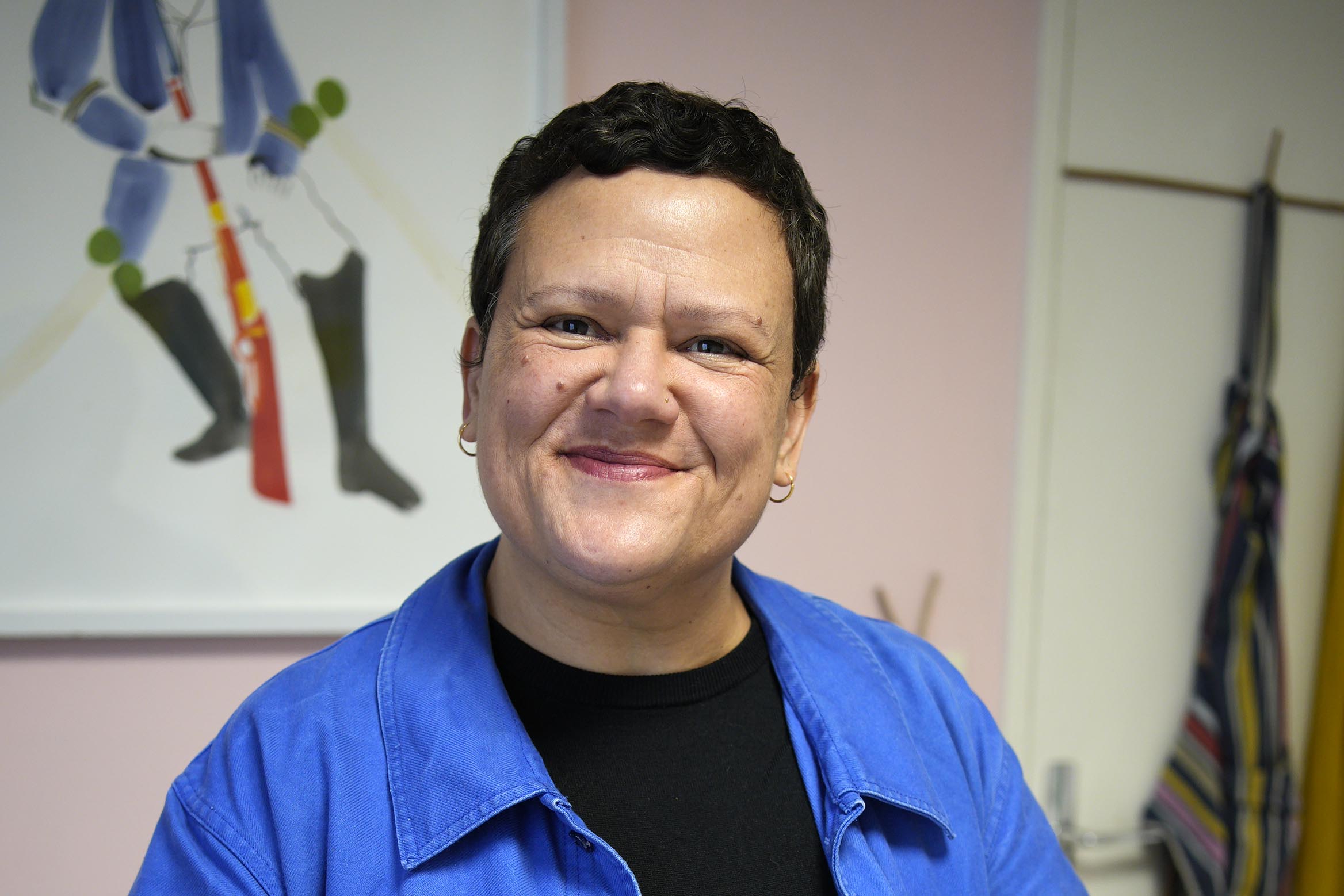
Gabrielle Manglou
Visual artist
June - July 2026
- Visual Arts
- New York

“I would like to discover where and how these ancestral, re-established, and grafted cultures still circulate, and to understand how they resist these solid yet hemorrhaging models.”
I am originally from Réunion, a young island born from a volcanic eruption in the middle of the Indian Ocean. This territory, initially uninhabited, was settled in successive waves (by Europeans, Malagasy, Africans, Indians, and Asians) during the early days of globalization, as they established trading posts and plantations there. This complex colonial history confronted me at a very early age with ontological questions underscored by the scarcity of material traces of our thwarted existences.
My artistic practice explores the realm of human relationships, where power, nature, culture, and hierarchy intersect—in other words, culture as a construct where a multiplicity of realities coexists with the persistence of certain imaginaries. Alterity is its driving force: it is the basis for relational momentum, that curiosity indispensable to any transformation, transmission, or learning. I explore the degree of porosity in these fields of knowledge and reflection by paying close attention to spaces of reconciliation and phenomena of hybridization.
Often deployed through installations where drawings, photographs, volumes, archives, and/or sound writings, my multifaceted practice plays with shifts and wide gaps between notions such as the exotic and the local, the dominated and the dominant, the act and the idea, mastery and non-mastery, the vernacular and the so-called universal, the true and the false, etc. I perceive my environment through detail—this detail fits into another detail, and so on, until it forms a string of pearls, a sort of score perceived as a tension between existence and resistance.
Gabrielle Manglou, born in La Réunion and based in Brittany, studied at the Beaux-Arts of Montpellier and Marseille. Her multidisciplinary work, often drawing on archival images, explores Creole identity, syncretism, and colonial heritage. Resisting categorization, she brings together gestures, objects, and memories to convey the complexity of the world through sensory experience. Her artist residencies in India, Africa, and Europe have enriched her practice. Her works are included in the collections of the FRAC Réunion, the Musée Léon Dierx, and several art libraries in France. A recipient of the CNAP’s Emanata commission, she also won the AWARE Nouveau Regard 2025 prize.
The art of spectacle, with its grandiose, glittering shows, is one of the most iconic showcases of the United States. This hypnotic, magical, sensational model—which many seek to imitate—brilliantly sidesteps the systemic fractures of a society founded on a sort of reversal of the poles. The glorious historical narrative is built on feats that render entire populations invisible, whether they are indigenous, deported, or displaced (the slave trade, imperial wars…). Behind this skillfully orchestrated myth, I would like to discover where and how these ancestral, re-established, and grafted cultures still circulate, and to understand how they resist this solid yet hemorrhaging model.
Aware of the clichés I myself may hold about this country, I wish to go out and meet these communities, to experience their daily lives, to grasp what persists and resonates from these worlds that have been attempted to be swallowed up. I want to explore museums and archives, memorials—these places where the true fabric of a territory that is both captivating and disconcerting is woven. For its tensions are also fertile. Through their interweaving, they take on inventive, explosive, and revolutionary forms, like jazz, the most telling example.
As a teenager, after seeing Martin Scorsese’s film “Gangs of New York,” I had a realization: New York and my island were cousins in many ways. This forced coexistence, this constant friction between these overlapping worlds, generates layers and interweavings in which we inevitably interact with a reality that is both elastic and powerful. In these shared living spaces, the multiplicity of systems—cultural, economic, linguistic, religious—constantly reshapes the question of identity. How is it constructed? On what fragile or resilient foundations does it rest? What are its breaking points, and what forces, on the contrary, make it porous and indomitable?
My approach is based on active polysemy: a reversal of vocabulary in which content and container swap places, blurring the lines. Through connections rooted in collective memory, an object or arrangement—evoking a gesture, an act, or an idea—is decontextualized and then reassociated. This alliance of contradictory concepts brings the bubbles of our dormant swamps to the surface.
New York, the ideal laboratory for this exploration, acts as a distorting mirror of my native island: the same dynamics of identity resistance, but on a radically different scale and from radically different perspectives. These tensions shed light on systems of domination, while revealing the cracks through which minority cultures seep in. My resolutely intersectional approach will seek to capture how these forces coexist, confront one another, and sometimes reinvent themselves.
My project, tentatively titled Erasure is not Leisure, draws on the repertoire of magic—its props, vocabulary, and rituals—to interrogate power dynamics and mechanisms of invisibilization. I aim to develop a formal grammar inspired by elements such as apparitions and vanishings, hats, scarves, boxes, curtains, cards, and mirrors, to examine tactics of selective visibility and erasure.
To this end, over the course of these two months, I would like to explore iconic sites such as Tannen’s, New York’s oldest magic shop; museums and memorials; archives (NYPL, Schomburg, Hunter College…); Harlem’s botánicas; the Forge Project; and working-class neighborhoods, where communities are reinventing a vibrant and resilient territory.
In partnership with

AWARE
AWARE: Archives of Women Artists, Research and Exhibitions is a non-profit organisation, co-founded in 2014 by Camille Morineau, art historian and specialist in the history of women artists. To counter the underrepresentation of women in the art world, AWARE seeks to rebalance the presence of women artists by giving them more visibility through the publication of free resources. The bilingual French/English website provides more than 900 biographies for women artists from the 19th and 20th centuries as well as articles and interviews written by researchers and curators from around the world.