

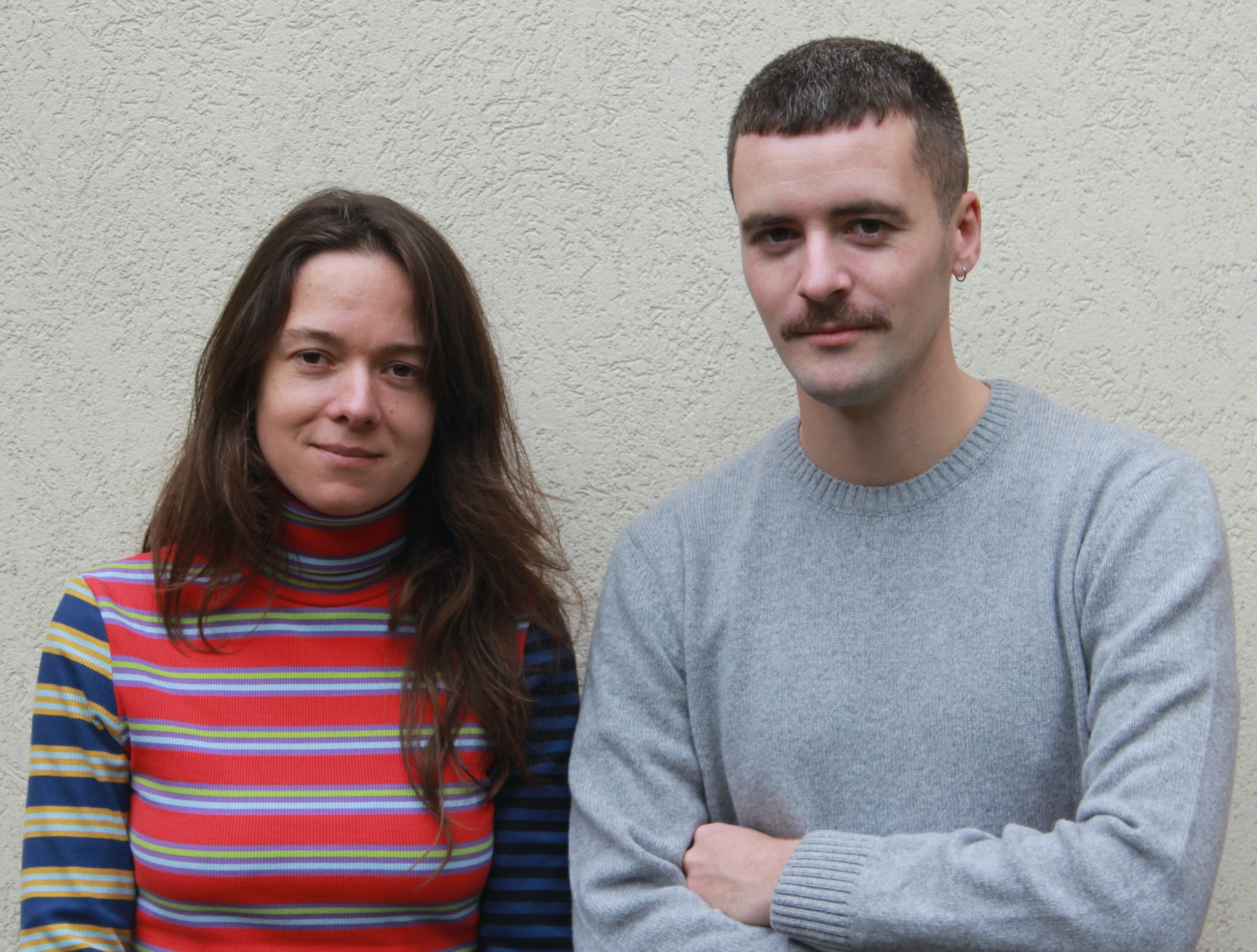
James Horton & Pascaline Morincôme
Art historians, curators
Spring - Summer 2027
- Museums
- New York
“We want to think through and think with Ann Wilson’s deconstructed oeuvre – a patchwork in its own right.”
We first began working together ten years ago at Treize, an independent non-profit arts and exhibition space in the 11th arrondissement.
As curators and art historians, we are interested in collaborative practices and how artists create alternative, networked spaces using different media and technology: Pascaline is currently completing her PhD thesis on participative film and video in the U.S. and Europe since the 1960s, while James’ doctorate focused on the intermedial “cut-up” technique and the countercultural networks through which it developed.
We have both worked extensively on American art, in particular in a transnational perspective, looking at histories of circulation, translation and intellectual exchange; in 2025, James was co-curator of the exhibition ECHO DELAY REVERB: American Art and Francophone Thought at the Palais de Tokyo (with Amandine Nana, François Piron and Naomi Beckwith), while Pascaline co-published an online research platform dedicated to the archives of EZTV, an artist-run space and micro-cinema founded in Los Angeles in 1979 (with Sibylle de Laurens and Gaspard Nectoux).
Our research also intersects around the question of artists’ writing, autofiction and alternative historiographies. From 2018 to 2023, Pascaline led a project to restore and exhibit the films of French author Guillaume Dustan, whose book Nicolas Pages James later translated for Semiotext(e).
Pascaline Morincôme is a researcher and curator. She is preparing a PhD in art theory and currently teaches at the Jules Verne University in Amiens. She was part of the programming team of Treize, an independent art space in Paris, from 2015 to 2024, where she notably organized, with Sibylle de Laurens in 2017, an exhibition dedicated to the American collective Videofreex. In 2019, she co-organized, with Julien Laugier and Olga Rozenblum, several screening series and retrospective exhibitions of the films of Guillaume Dustan (1965–2005).
James Horton is an art historian, curator and translator. He holds a doctorate from the Ecole normale supérieure in Paris, and is an associate member of the Institut de l’histoire moderne et contemporaine. In 2025, he co-curated the exhibition ECHO DELAY REVERB at the Palais de Tokyo. From 2026, he will be a postdoctoral researcher at the Institut national d’histoire de l’art in Paris as part of the project Objets minoritaires that looks to use archival and museum resources to write histories of non-normative sexual cultures and communities.
Our research focuses on the life and work of the artist, writer, director, performer and set designer Ann Wilson (1931-2023). From the 1950s onwards, Wilson participated in successive avant-garde communities in New York and beyond, from the Coenties Slip group to the mail art networks of Ray Johnson, the feminist circles of Jill Johnston and Harmony Hammond, Paul Thek’s Artist’s Co-op and Robert Wilson’s theatre troupe. These collaborative endeavours were interwoven with a career as a painter. Wilson’s solo practice centred on a form that again suggests multiplicity: from the 1950s, she carried out experiments with patchwork quilts, stretching them on canvas and overpainting them or transposing their motifs into drawings and collages. At the same time, she was a prolific writer and diarist, penning critical texts on the work of her friends that blended everyday anecdotes with literary and religious references.
As a ghostwriter, performer or artistic collaborator, Wilson continuously lent her voice, her body and her art to her circle of friends, working as a catalyst to sublimate her own subjectivity in the reactions she created. Her approach to making art and recording, re-enacting and reimagining its histories involved a constant distribution of her identity and her production amongst her collaborators. Jill Johnston likened her to Pirandello: an author sought out by an unruly cast of characters from the New York avant-garde in search of a voice.
Through archival research across the New York area and through interviews with her collaborators, we want to think through and think with Ann Wilson’s deconstructed oeuvre – a patchwork in its own right – through a collective monograph featuring interviews, reproductions and an anthology of texts, as well as through an exhibition featuring archival documents, original works by Wilson, recreations of two of her key installations, and contributions from her circle and by contemporary performance and textile artists.
New York was where Ann Wilson lived and worked from the 1950s onwards in between her numerous voyages to Europe and further afield with her friends and collaborators, who we will look to interview as part of an approach that foregrounds oral history. During her lifetime, Wilson participated in and contributed to an artistic and social world in the city that was structured around a tissue of alternative spaces and performance venues such as The Kitchen, the A.I.R. Gallery, Artist’s Space and Creative Time, one that still exists today, albeit transformed; alongside archival research that we hope to conduct at institutions such as Robert Wilson’s Watermills Centre on Long Island, we hope to pursue our project in dialogue with these spaces and their contemporary equivalents, many of which play close attention to experimental writing and performance as well as the visual arts. Similarly, to better understand the social and aesthetic resonance of the form at the centre of Ann Wilson’s production, the patchwork quilt, and the gestures and material concerns that she dealt with, we will look to meet with collectors, historians and contemporary quilters.
In partnership with

Bétonsalon
Bétonsalon develops its activities in collaboration with local, national and international organisations. The programming includes monographic or group exhibitions of emerging, re-emerging, established or forgotten artists, multidisciplinary events with the best possible quality of listening and exchange, mediation actions and research on experimental pedagogies, research and creation residencies, projects outside the walls that are woven with local audiences and structures, and actions that are not yet listed. Bétonsalon is a non-profit association created in 2003. Located on campus at the Université Paris Cité, in the 13th arrondissement since 2007, Bétonsalon – Center for art and research is a cultural establishment of the City of Paris.