

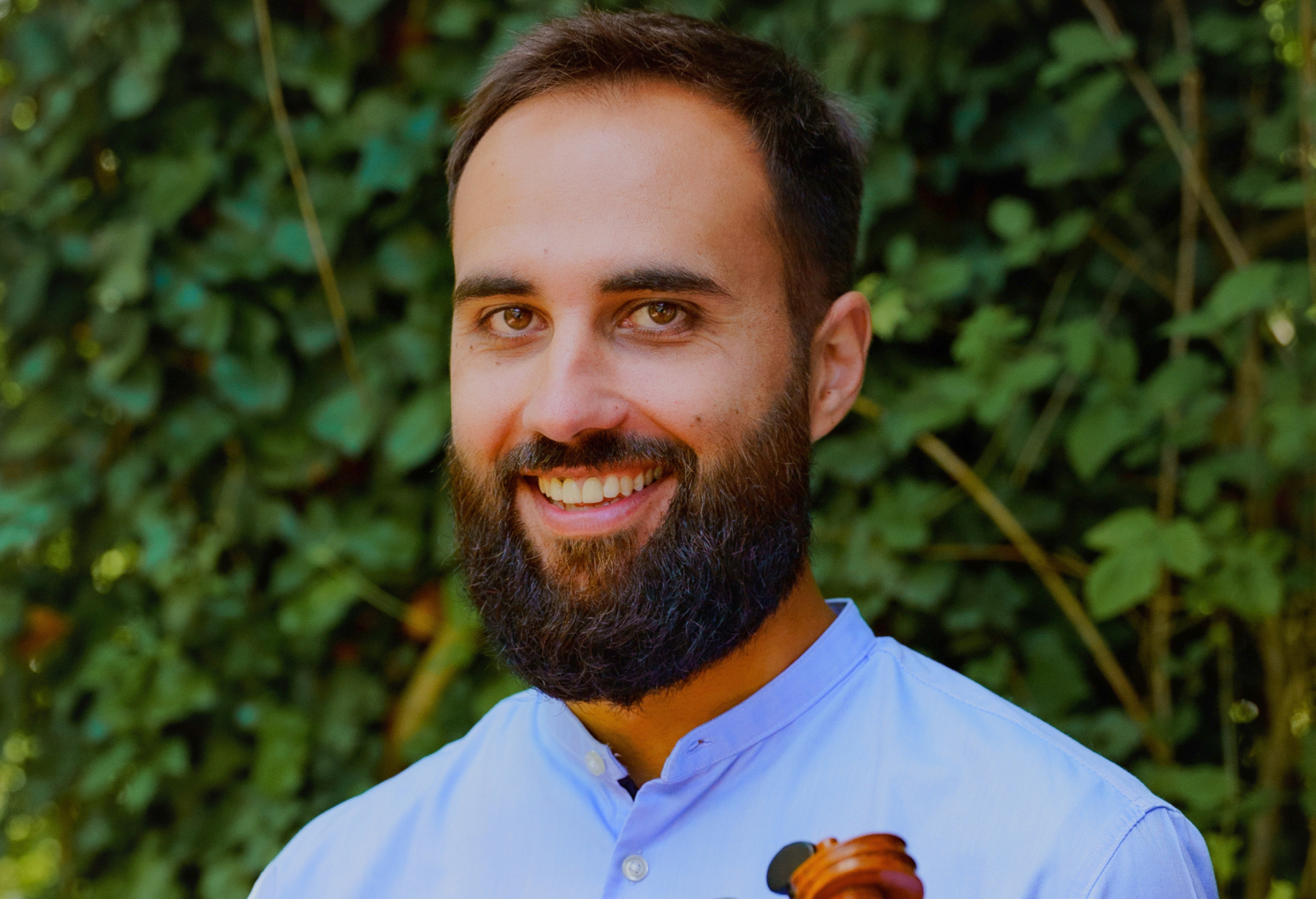
Alix Boivert
Musician
February 2027
- Classical Music
- Boston
- New York
- Washington, DC
“What fascinates me is the way a melody leaves one territory, crosses borders, changes through contact with other cultures, and ultimately comes to tell a new story.”
I have always been more interested in the journeys music takes than in its fixed history. What fascinates me is circulation: the way a melody leaves one territory, crosses borders, changes through contact with other cultures, and ultimately comes to tell a new story.
This curiosity led me, more than ten years ago, to move to Dublin to study eighteenth-century Irish and Scottish musical sources. Since then, my research has taken me to libraries, archives, and private collections in Ireland, Scotland, England, Norway, and Sweden, where I have encountered a largely forgotten musical heritage. Gradually, I came to understand that these so-called “traditional” musics were not static inheritances, but living forms, shaped by migration, exchange, and the upheavals of history.
This conviction led to the creation of The Curious Bards. With this ensemble, I seek to bring historical research into dialogue with musical practice. Manuscripts, printed collections, and visual sources are never an end in themselves for me: they are the starting point for an interpretation that restores the breath, spontaneity, and popular dimension of these repertoires.
Today, this approach naturally leads me toward the United States. The British musics I have been studying for years underwent a decisive transformation there through their encounters with African and Native American traditions. Understanding this transformation means continuing an investigation that began in Europe and exploring the moment when a musical memory becomes a new culture.
Alix Boivert is a violinist and artistic director. A graduate of the Conservatoire National Supérieur de Musique et de Danse de Lyon, he founded The Curious Bards in 2015, an ensemble dedicated to the popular music of Northern Europe in the eighteenth century. His work, at the intersection of musicological research and historically informed performance, has led him to perform in more than 300 concerts across Europe and record four albums with Harmonia Mundi.
For several years, I have been exploring the popular repertoires of the British Isles in the eighteenth century. Over the course of my research, one question has become unavoidable: what became of these musics when they crossed the Atlantic with the first settlers and took root in a new territory in the making?
My project is to follow this musical migration to the North American colonies, where these repertoires encountered other traditions and began to transform. I want to trace this history through printed collections, manuscripts, street songs, newspapers, instruments, and archives preserved in major American institutions, but also through more modest, sometimes peripheral sources that offer alternative perspectives on these circulations.
I am not simply seeking to identify melodies or lines of transmission. What interests me is the process of transformation itself. How does a Scottish tune become an American song? How do dance practices evolve? What exchanges take place between Anglo-Irish traditions, African musical cultures, and the practices of Indigenous peoples?
Through these questions, the gradual emergence of an American musical identity begins to take shape, long before it was given that name.
This residency will above all be a period of observation and research. Upon my return, this material will form the basis of a new concert program with my ensemble, The Curious Bards, combining previously unpublished pieces, historical arrangements, and performances on period instruments, some of which may be reconstructed from models studied during the journey. The project will also result in a recording.
Rather than simply reconstructing the past, I want to tell a story of circulation, cultural mixing, and transmission, in which music becomes a sensitive witness to the movements of history.
For me, the United States represents less a destination than a new point of departure. For several years, I have been studying European popular music before it left for the New World; it is now time to follow its journey to the territory where it would profoundly change in character.
Boston, New York, and Washington, D.C. form the three essential stages of this research. In Boston, I want to trace the earliest evidence of repertoires brought to the colonies through printed collections, dance manuals, and early American musical editions. New York interests me for the cultural diversity that characterized the city as early as the eighteenth century: it offers a privileged setting in which to observe encounters between traditions brought from Europe and local practices. Finally, Washington, D.C. holds exceptional collections that will allow me to study instruments, their construction, and the practices surrounding them.
Beyond heritage institutions, this residency offers an opportunity to engage in dialogue with those currently working on these questions: curators, researchers, instrument makers, musicians, and programmers. I want to bring my perspective as a European musician into conversation with theirs and enrich my research through these exchanges.
The 250th anniversary of American independence gives this investigation a particular resonance. At a moment when the country is reflecting on its history, I want to return to one of the narratives that has accompanied it since its origins: that of a music born from encounters, movements, and cultural mixing, whose echoes continue to cross the Atlantic.
In partnership with

harmonia mundi
harmonia mundi is an independent French record label founded in 1958 by Bernard Coutaz and based in Arles, primarily dedicated to classical music, from early music to contemporary repertoire, and renowned for its artistic excellence and high-quality recordings.
Musicancy
The Musicancy Festival is a music festival based in Ancy-le-Franc, in France’s Bourgogne-Franche-Comté region. Held each summer in the Château d’Ancy-le-Franc, it brings together early music, contemporary creation, jazz, storytelling, and participatory formats, combining artistic excellence with cultural transmission and a strong connection to the local community.
Societe Generale Foundation
The Societe Generale Foundation contributes to the development of a more inclusive and sustainable society by supporting initiatives that generate a positive social impact in the fields of Education, Culture and the Environment. Driven by an entrepreneurial spirit, it provides support to structures of general interest and cultural organizations that carry out projects with a high impact potential, whether they are incipient or large-scale initiatives. The Foundation operates in France, at both national and regional level, and also supports multi-country or internationally oriented projects.
As a major partner of Villa Albertine’s residencies, the Societe Generale Foundation is committed, through this exceptional partnership, to supporting the career development of artists and promoting artistic excellence. It contributes to transatlantic dialogue through the arts and to the international reach of French culture. The Foundation particularly supports the development of classical music within the residencies through a dedicated call for projects, continuing a commitment spanning nearly 40 years in this field. This partnership also builds upon the Societe Generale Group’s ongoing support of contemporary art for the past 30 years, notably through a collection of nearly 1,800 works — paintings, graphic arts, photographs and sculptures — by French and international artists. Through these commitments, Societe Generale reaffirms its dedication to artistic creation and excellence, in France and internationally.
For more information, visit https://fondation.societegenerale.com/en.