
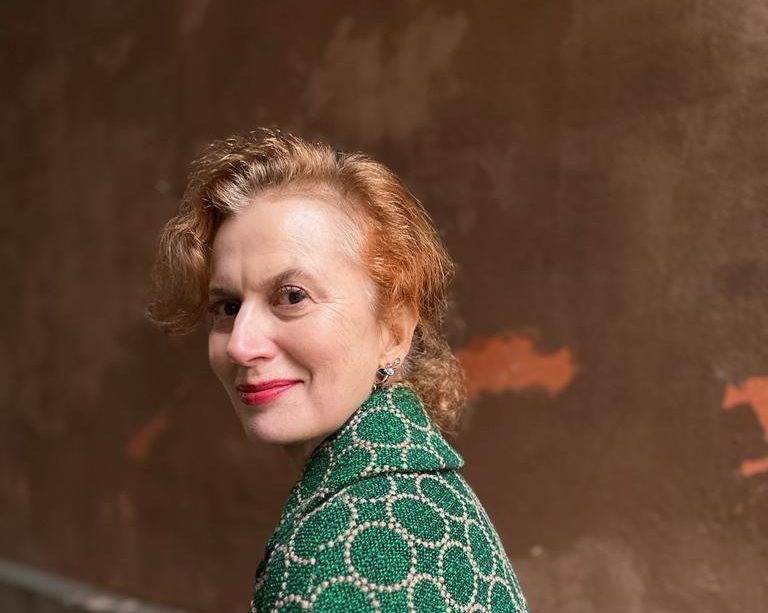
Lou Jeunet
Filmmaker
February 2027
- Cinema
- Los Angeles
- San Francisco

“I hope to meet a new generation of Californian women chefs, in conversation with, or deliberately departing from, the French farm-to-table tradition. I want to understand how they transform memory, landscape, and personal experience into stories through food, and whether M.F.K. Fisher’s invention of the food memoir still resonates today.”
I make films to celebrate the beauty of bodies. Young or old, fragile or defiant, restrained or wildly alive, bodies have always been the raw material of my imagination. Rooted as much in painting and photography as in cinema, my practice begins with images rather than stories.
My process is almost artisanal. I collect traces, press clippings, anonymous photographs, archival fragments, and assemble them into notebooks until a visual world emerges. These constellations of images become my first script, from which the narrative gradually unfolds. What begins as an intimate visual exploration later becomes a shared language for the entire crew, from the cinematographer to the production and costume designers. During the preparation process, the film’s visual découpage grows directly out of photographs of locations.
My cinema is visual before it is narrative. I often carry vivid mental images of scenes long before I know how they belong to a story. Writing becomes a way of preserving the emotional force of those visions rather than explaining them away. These intuitive images often evolve into the most unexpected and emotionally resonant moments in my films. They also shape my work with actors, guiding the choreography of bodies, gestures, and distance.
Whether I work in film or television, my gaze remains anchored in the relationship between body and image. Television has been a laboratory in which I explore genre while remaining deeply connected to performers. Over the years, I have become known for directing intimate scenes with care and precision, creating an atmosphere of trust in which actors remain active, powerful subjects rather than passive objects of the camera.
Born in Dijon, Lou Jeunet trained at France’s National Film School (IDHEC, now La Fémis) before beginning her career working on Roman Polanski’s Frantic. While directing a documentary in London about Virginia Woolf and Vanessa Bell through the Villa Médicis Hors les Murs program, she developed a lasting interest in Anglo-American Francophilia and cultural displacement. Her television film Favourite Daughter won the Best Screenplay Award at the Monte-Carlo Television Festival and was nominated for an International Emmy Award. Her feature debut, Curiosa, was released internationally. She is currently developing a new feature exploring the creative dialogue between French and American cultures.
My feature film is freely inspired by the life and work of M.F.K. Fisher. Rather than a biopic, it is a fictional origin story imagining the emergence of her singular voice and of a new literary form: the food memoir. Set in 1932, the film follows a young American woman arriving alone in Burgundy, where her discovery of terroir gradually transforms her relationship to taste, memory, and writing.
I approach this project not as a biographer, but as a filmmaker drawn to the dialogue between cultures. Born in Dijon, where Fisher spent two formative years, I share with her an intimate connection to this landscape. My research in the city’s municipal archives has deepened my understanding of the social and culinary world she encountered.
The Villa Albertine residency will allow me to deepen both the writing and the visual development of the film. I hope to collaborate with an American co-writer to refine the dialogue and ensure the authenticity of my American characters. I also plan to revisit M.F.K. Fisher’s estate with her daughter, whom I already know, before undertaking a field study across California. I want to keep a filmed travel journal, observing landscapes, vineyards, kitchens, and conversations that will become the visual notebook for the film.
I also hope to meet a new generation of Californian women chefs, in conversation with—or deliberately departing from—the French farm-to-table tradition. I want to understand how they transform memory, landscape, and personal experience into stories through food, and whether M.F.K. Fisher’s invention of the food memoir still resonates today. Their reflections will nourish both the screenplay and my understanding of the creative dialogue between French and American culinary cultures.
I approach this project not as a biographer, but as a filmmaker drawn to the dialogue between cultures. California is not a parallel research destination; it is essential to the film’s foundation. It is the world Mary leaves behind when she departs for France in 1932. To write her journey, I need to understand the social and cultural landscape that shaped her: the Great Depression, the rise of industrial food production, the expansion of advertising, and changing relationships with food. Through the archives of the St. Helena Public Library and the Napa Valley Wine Library, I want to study magazines, advertisements, and food publications from the period in order to reconstruct the world from which Fisher’s voice emerged.
In Los Angeles, I will focus on the screenplay. My co-writer on another project, Julie Peyr, lives there, making it an ideal place to rethink the dramatic structure and collaborate with an American screenwriter who can refine the dialogue and voices of the film’s young characters.
In Glen Ellen, near San Francisco, I plan to visit M.F.K. Fisher’s home with her daughter, especially the red-lacquered kitchen lined with cookbooks. Being in this space will help me understand the emotional and visual starting point of the film.
In the Bay Area, I want to undertake a cinematic field study, keeping a filmed travel journal while exploring vineyards, kitchens, landscapes, and local food cultures. Through conversations with chefs, food writers, and critics, I hope to explore how memory, landscape, and personal experience shape the way food becomes narrative. These encounters may become the foundation for a documentary companion to the fiction film.
In partnership with

Paradise City Films
Based in Paris and London, Paradise City is a talent-driven production company and management firm with a vision that comes from Emilie Georges and Naima Abed’s collective experience within Memento International and La Cinéfacture, and our combined track record in acquiring, selling and producing award winning films including Luca Guadagnino’s Call Me by your Name, Justin Kurzel’s True History of the Kelly Gang, Nicolas Pesce’s Piercing, Anthony Chen’s Drift.