

Garance Früh
Artist
March 2027
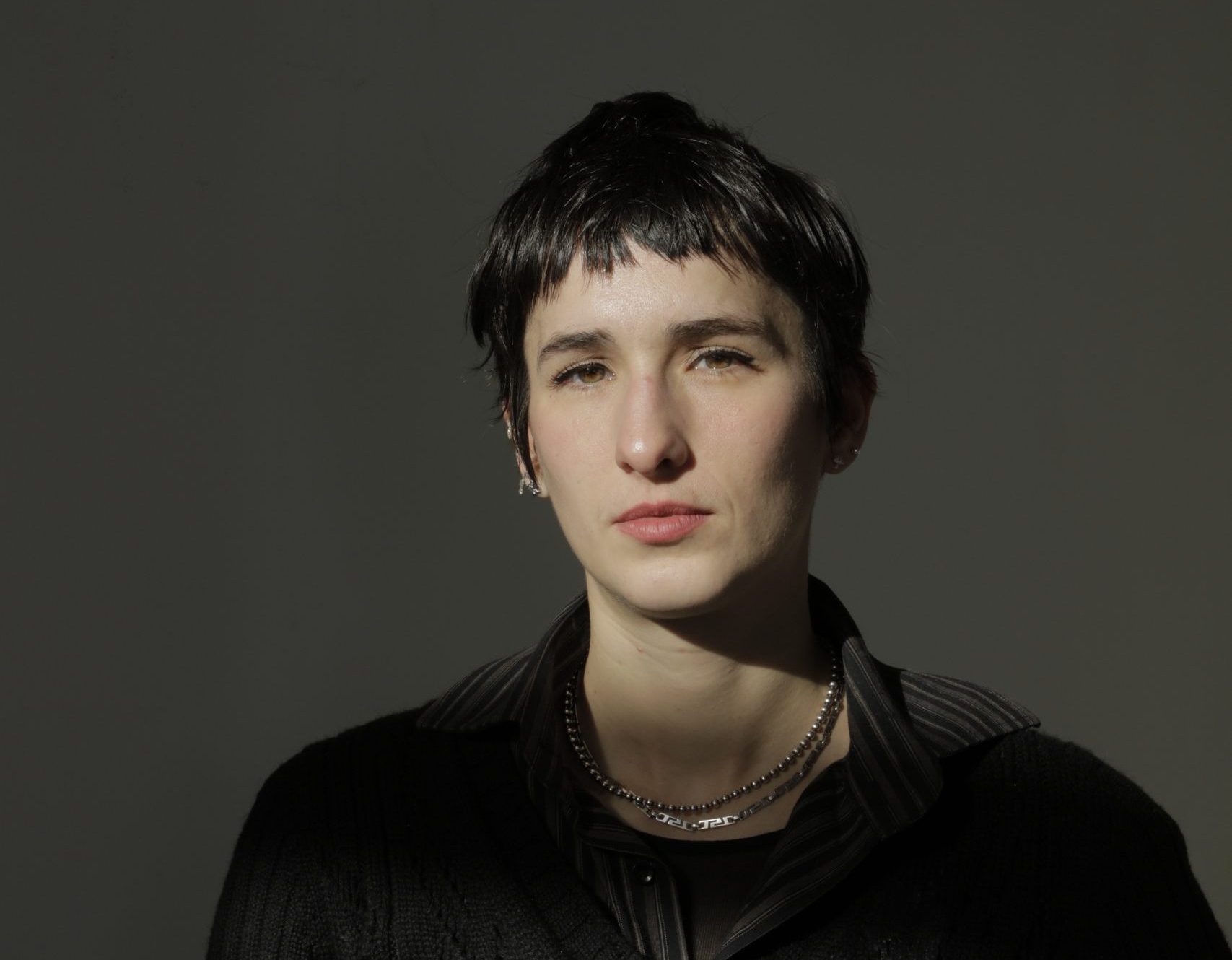
- Visual Arts
- Boston

“My project approaches Spiritualism not as a religious phenomenon, but as a social, embodied, and performative apparatus. I will focus particularly on the ways in which séances altered the uses of the body: postures, gestures, movements, occupation of space, and transformations of identity.”
In my sculptural practice, I recontextualize everyday objects by combining them with elements whose qualities appear contradictory. Sports equipment designed to protect the body is brought into dialogue with childcare objects, delicate textiles, accessories associated with seduction, or fragile forms cast in ceramic.
Through these sculptures and installations, I explore the relationships between protection, defense, vulnerability, gender, control, and power. By bringing together objects associated with masculine and feminine registers, robustness and fragility, protection and constraint, I seek to challenge the binary systems of classification that shape our relationship to bodies. Sensitivity, softness, care, and dependence appear not as signs of weakness, but as forms of resistance and emancipation. Questions of motherhood, gestation, care, and transmission also play an important role in my research, particularly through the use of objects and materials associated with childhood and the protection of bodies.
My recent research has incorporated nineteenth-century women’s clothing—including crinolines, corsets, and bustles—considered as devices capable of both constraining and shaping the body. This line of inquiry led me to study the early women’s rights movements and their intersections with American Spiritualism, where questions of the body, performance, authority, and emancipation take on particularly complex forms. The Villa Albertine residency represents an opportunity for me to deepen this research and develop a new body of sculptures from it.
Garance Früh is a French visual artist whose practice focuses on sculpture and installation. Her work has been presented at institutions and galleries including FRAC Île-de-France, Fondation Pernod Ricard, Ciaccia Levi in Paris, FRAC Pays de la Loire, In Extenso in Clermont-Ferrand, BQ in Berlin, as well as in Japan.
Shortlisted for the Reiffers Art Initiatives Prize in 2024, she was a production resident at Lafayette Anticipations in 2025. That same year, one of her works entered the collection of FRAC Île-de-France.
When Tables Turn is a research project that takes as its starting point the emergence of the American Spiritualist movement in the nineteenth century and its role in the history of feminist struggles. In a society where women were largely excluded from political, religious, and intellectual spheres, Spiritualism provided a paradoxical space for public expression. Regarded as mere intermediaries between the world of the living and the spirit world, some female mediums nevertheless found in this position a means of gaining visibility, economic independence, and authority. By embodying the voices of recognized male figures—scientists, philosophers, and political leaders—they were able to occupy spaces from which they were ordinarily excluded.
My project approaches Spiritualism not as a religious phenomenon, but as a social, embodied, and performative apparatus. I will focus particularly on the ways in which séances altered the uses of the body: postures, gestures, movements, occupation of space, and transformations of identity. I seek to explore how trance states could open up alternative forms of presence and expression at a time when women’s behavior was subject to strict social norms.
This research will draw on archival work, the consultation of historical documents, and the study of images and accounts of séances, as well as visits to sites connected to Spiritualism and the history of free thought in the United States.
The residency will allow me to assemble a body of materials—including notes, images, films, documents, and sculptural experiments—that will serve as the basis for a future series of sculptures exploring questions of voice, authority, mediation, and embodiment.
The United States occupy a central place in the history of modern Spiritualism. It was in the northeastern United States that the movement developed from the mid-nineteenth century onward, before becoming a major social phenomenon closely connected to debates around women’s rights, social reform, free thought, and new forms of public participation.
Boston represents a particularly relevant starting point for this research. The city has a rich intellectual and political history, shaped by abolitionist movements, feminist activism, and religious experimentation that accompanied the emergence of Spiritualism. It also provides privileged access to collections, archives, and institutions that could shed light on the historical and cultural dimensions of my project.
I would like to meet with art historians, specialists in Spiritualism, curators, artists, and archivists whose work explores the relationships between the body, performance, belief, and power. These exchanges will allow me to deepen my understanding of the contexts in which mediumistic practices emerged and evolved.
I would also like to visit sites connected to the history of Spiritualism, free thought, and nineteenth-century reform movements, as well as collections dedicated to spirit photography and alternative forms of knowledge production.
Beyond their historical significance, this research resonates with my current artistic concerns. It will allow me to examine how certain voices manage to be heard and legitimized, or conversely marginalized, and to explore the material and embodied forms through which these mechanisms take shape.
In partnership with

Palais de Tokyo
Europe’s largest contemporary art centre, the Palais de Tokyo is home to an exceptional, multisensorial and boundary-defying experience of artistic creation that is infused with the questions that shape our contemporary world. The Palais de Tokyo serves as an engaged and accessible space of reflection, where dreams and imagination develop into curiosity and awareness, where contemplation and escapism stimulate creativity and knowledge, and where artistic inclusivity fuels a process of individual and collective transformation.