

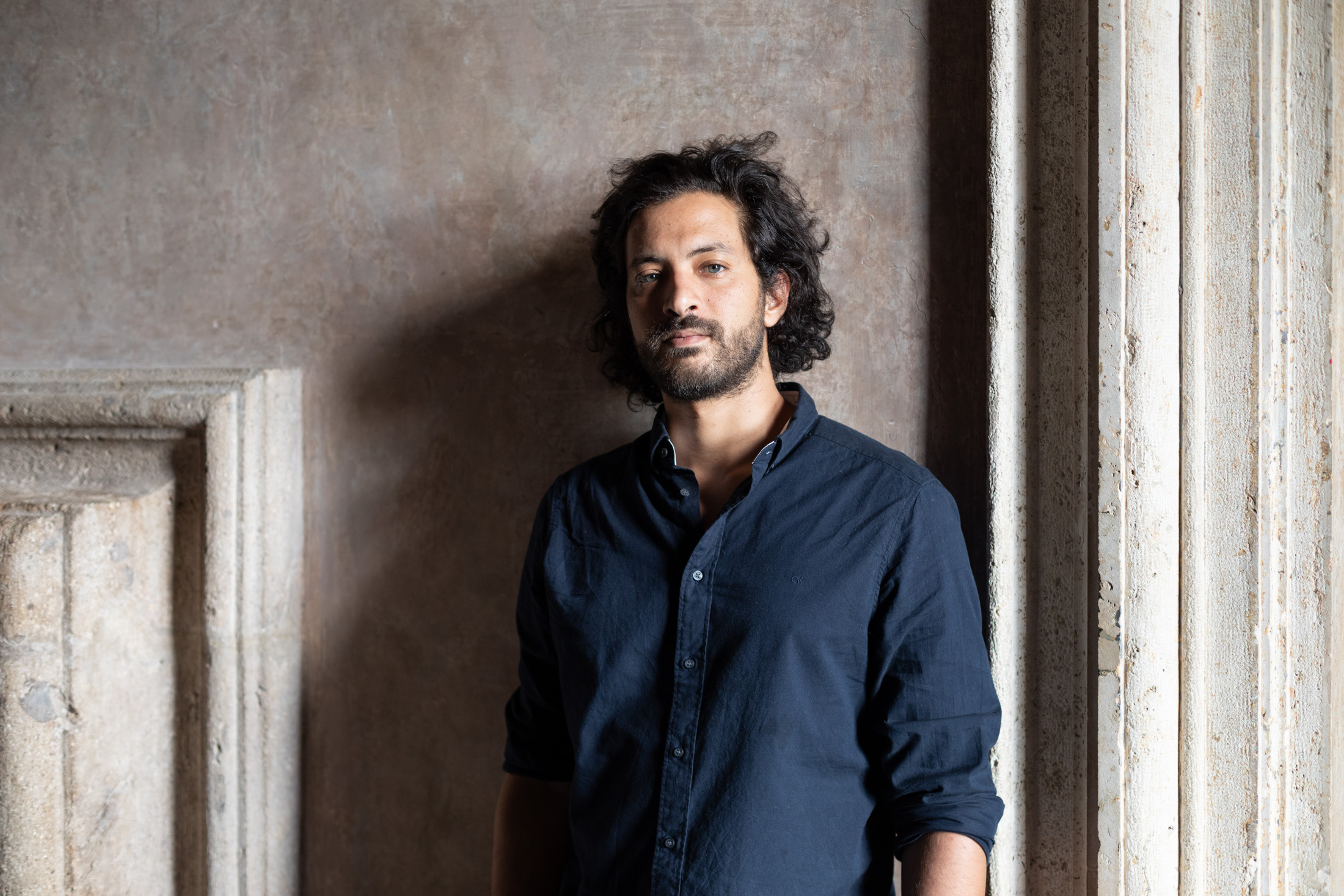
Mounir Ayache
Artist
Novembrer-December 2026
- New Media
- Houston
- Los Angeles
- San Francisco

“I plan to develop a constellation of small “myth engine prototypes” rather than a single finished piece.”
I am a visual artist working between France and Morocco, with a practice rooted in North Africa and its diasporas. I use 3D, game engines, video, still image and installation to explore how places, stories and archives from the Maghreb, West Africa and the Arab world can be projected into speculative futures.
Since graduating from the Beaux-Arts de Paris, I have been fascinated by the way the “Arab world” and “Africa” are portrayed by American cinema, series and games: powerful images that circulate everywhere, often built on a narrow, orientalised or exotic gaze. Rather than staying only in critique, I try to step inside these narrative and technical systems – script structures, genre codes, VFX, virtual production, game design – and reuse them to tell other stories.
Over the last years, I have developed projects that connect heritage, science fiction and digital tools. I work with 3D scans, photogrammetry and real-time engines to transform archaeological sites, mosques, Sahelian cities or port infrastructures into unstable worlds affected by climate change, conflict or technological acceleration. Artificial intelligence now plays a growing role in my process, helping me to navigate archives, generate visual hypotheses and test narrative structures.
My current projects move between experimental installations and playable environments. They all share the same question: how can tools associated with Western entertainment be reoriented to host myths, memories and futures emerging from North and West Africa and the broader Arab region?
Mounir Ayache is a visual artist working between France and Morocco. A graduate of the Beaux-Arts de Paris, he combines 3D scanning, game engines, video and installation to project architectures, myths and archives from North and West Africa and the Arab world into speculative futures. His recent projects include immersive installations and game-based environments developed from heritage 3D scans and field recordings. He has presented his work in dialogue with researchers and institutions in Europe and abroad, notably within NYU’s Silsila program on the art and history of the Islamic world.
My project for Villa Albertine is a research-creation journey around what I call “myth engines”: the systems that produce large-scale stories today–US entertainment industries, AI-driven creative tools and the space program. I want to bring these myth engines into dialogue with myths, archives and cosmologies from the Maghreb, West Africa and the Arab world, and see how they can host new speculative futures when activated from my position between France and Morocco.
My work already starts from concrete places and archives in North and West Africa–archaeological sites, UNESCO-scanned cities, oral histories–which I transform into future worlds through game engines and moving image. The residency would extend this approach by observing from within how American narratives about history, race, territory and the future are constructed, and by reusing their narrative grammars for other protagonists, geographies and timelines.
Concretely, I plan to develop a constellation of small “myth engine prototypes” rather than a single finished piece. These prototypes will take the form of short real-time scenes in a game engine, sketches for immersive installations and narrative blueprints. Each will connect one or more American contexts (cinema and series, AI ecosystems, space imaginaries) with specific stories, landscapes or archives drawn from the Maghreb and West Africa.
The aim is to return from the residency with documented prototypes, texts and visual materials that will feed several projects: new installations, a game-based work and hybrid formats between exhibition and performance, forming the next chapter of my long-term research.
The United States is essential to do this project because many of the myth engines I work with are structurally based there. I am particularly interested in three regions that reflect different layers of this system: Southern California’s entertainment ecosystem, the San Francisco Bay Area’s AI and tech infrastructures, and the space-related institutions around Houston.
In Los Angeles, I want to be close to the factory of contemporary myths: film and TV production, writers’ rooms, game and VFX studios, and virtual production stages using LED walls and real-time environments. I am interested in how histories and racialised geographies are translated into genres, characters and visual clichés, and I hope to meet writers, narrative designers, artists and researchers who reflect on these questions from within and around the industry.
In the Bay Area, the focus shifts to AI systems, creative software and research labs that now shape how images, texts and worlds are generated. AI is already part of my practice; spending time there would allow me to speak with engineers, artists and scholars about how these tools transform writing, world-building and the handling of archives, and how these transformations resonate with sensitive materials from North and West Africa.
Around Houston, my interest lies in the narratives of the space program and their links to frontier mythology and national identity. I would like to confront these narratives with North African and Sahelian cosmologies and with my own family history connected to the Hermès spaceplane project, in dialogue with curators, historians of science and artists working with aerospace archives.
In partnership with
Recanati-Kaplan Foundation
Created in 2010 by Thomas S. Kaplan and Daphne Recanati-Kaplan, the Recanati-Kaplan Foundation supports the development of initiatives of excellence in four areas: the protection of our biodiversity; research in medical sciences; the teaching of history and philosophy; and cultural, artistic, and intellectual bridge-building between the Arab world, France and the United States.
Institut du monde arabe
The Institut du monde arabe was founded in 1980 by France and the League of Arab States to promote and highlight Arab culture in all its forms. Housed in a building designed by the eminent architect Jean Nouvel and Architecturestudio, this genuine hub of encounters and exchanges opened its doors in 1987. For the past 35 years, the Institut du monde arabe has continued to strengthen cultural, political, economic, and social connections between France and the Arab world.